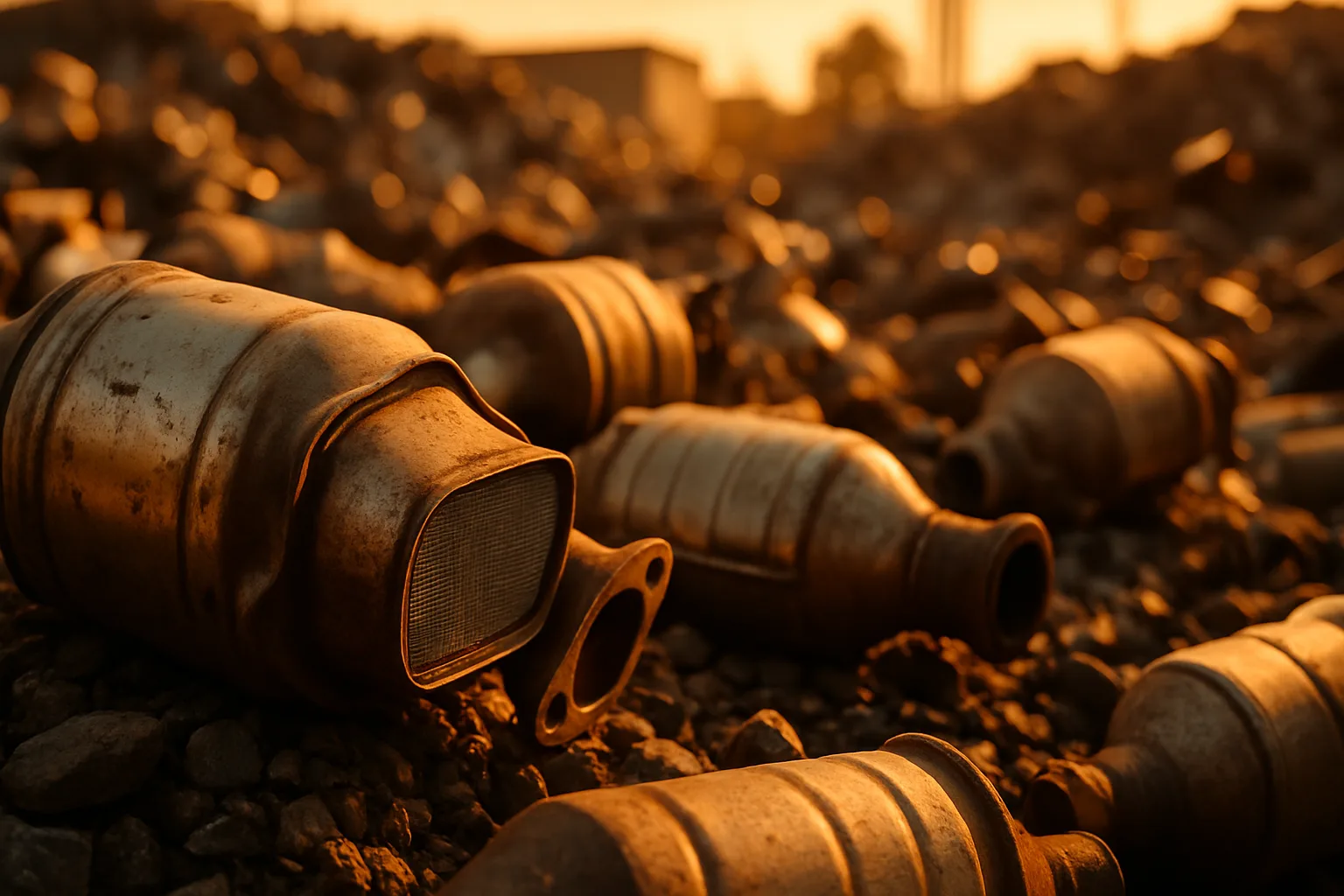
Rhodium hit over $29,000 per troy ounce at its peak — and even at today's more moderate levels, it still makes palladium and platinum look like budget metals. If you're sitting on a pile of scrap catalytic converters and only watching the palladium price today, you're leaving serious money on the table by ignoring the other PGMs inside each unit.
This article breaks down why rhodium commands such an extreme premium, how it affects your scrap cat value, and what you need to do differently if you want to get paid what your converters are actually worth.
What Makes Rhodium So Valuable in a Catalytic Converter?
Catalytic converters contain three platinum group metals — platinum, palladium, and rhodium. Each one does a specific job inside the converter's ceramic substrate. Rhodium handles the hardest task: reducing nitrogen oxides (NOx) into harmless nitrogen gas. No other metal does this job as efficiently at the temperatures and pressures inside an exhaust system.
That's the core reason rhodium is so expensive. It's not just rare — it's functionally irreplaceable in emissions control. Global supply is extremely tight. Rhodium is almost never mined on its own. It comes out as a byproduct of platinum and palladium mining, primarily from South Africa, which controls the overwhelming majority of world supply. When auto production ramps up or emissions standards tighten, demand spikes and supply can't keep pace.
Compared to palladium, rhodium typically trades at a significant multiple — sometimes 5x to 10x or more depending on market conditions. That spread matters enormously when you're evaluating used catalytic converter scrap value. Even a small amount of rhodium in a converter can represent a large portion of its total PGM value.
Why Watching the Palladium Price Today Isn't Enough
Most scrap sellers track the palladium price today as their primary pricing signal. That makes sense — palladium has historically been the highest-volume PGM in modern converters, particularly in gasoline-engine vehicles. But if you're using palladium pricing as a proxy for your entire cat's worth, you're working with incomplete information.
Here's the problem: different converters have wildly different PGM ratios. A late-model truck converter might be loaded with palladium and modest in rhodium. A European diesel converter might lean more heavily on platinum. Certain high-performance or emissions-sensitive vehicles carry a disproportionately high rhodium load relative to their size.
If you're not accounting for the rhodium content — specifically — you're either underpricing your cats or trusting buyers to be honest about the split. In a market where a single point of rhodium concentration can mean hundreds of dollars per unit, guessing is a losing strategy. Platforms like find the best price for your scrap on SMASH help you put documented inventory in front of multiple vetted buyers simultaneously, so the market — not one buyer's lowball — determines what your load is worth.
The Rhodium Supply Problem Isn't Going Away
In 2026, the structural supply constraints on rhodium remain unchanged. South African mining operations still account for the bulk of global production, and secondary supply — meaning refined rhodium recovered from scrap — plays a smaller role compared to platinum and palladium. That makes scrap catalytic converters genuinely important to the global PGM supply chain. Your old cats aren't junk. They're a legitimate source of a metal the auto industry needs.
Emissions regulations in the U.S. and globally continue to pressure automakers toward higher PGM loadings in their catalysts. Stricter NOx limits in particular push OEMs to use more rhodium per unit, not less. Even as battery electric vehicles take a growing share of new sales, the existing fleet of internal combustion vehicles will generate scrap cats for decades. The scrap market for PGMs isn't shrinking.
Understanding this dynamic helps you approach buyers from a position of knowledge. You're not disposing of waste — you're selling refined-in-process metal that has real, traceable value. Yards in Pennsylvania and across the Northeast are seeing consistent demand for quality documented loads. If you're in the Allentown area and selling locally, know that buyers are competing for this material. That competition is leverage — if you use it.
Scrap Catalytic Converter Prices in Allentown — What the Local Market Looks Like
Allentown sits in the Lehigh Valley, a region with significant industrial and automotive activity. That means there's a real local market for scrap cats, and there are multiple buyers operating in the area. The challenge for sellers is that local pricing is still largely relationship-driven and opaque. You call one buyer, you get one number, and you have no easy way to know if it's fair.
Scrap catalytic converter prices in Allentown follow national PGM spot markets — platinum, palladium, and rhodium prices all directly influence what a buyer can offer. But the spread between spot and what you actually receive can be significant depending on the buyer's margin structure, how they hedge their position, and whether they're even accounting for rhodium accurately.
For sellers in Pennsylvania looking to move material, the smartest move is to document your inventory thoroughly — serial numbers, photos, VIN lookups where applicable — and present it to multiple buyers simultaneously. That's exactly what get a fair price for your scrap catalytic converters is built around. Competition between buyers is the most reliable way to close the gap between what you're offered and what your material is actually worth.
A few things that affect your price in any market, including Allentown:
- Converter type and application — foreign catalysts generally carry different PGM ratios than domestic units
- Condition — damaged, cracked, or gutted converters return significantly less
- Documentation quality — buyers pay more confidently when they know exactly what they're bidding on
- Volume — larger, well-sorted loads attract more serious buyers
- Timing relative to spot prices — selling when rhodium and palladium are strong improves outcomes
Scrap Metal Inventory Management: The Part Most Sellers Skip
Scrap metal inventory management sounds like a back-office problem, but for catalytic converter sellers, it directly impacts how much you get paid. Buyers price uncertainty into their offers. If they can't verify what's in your load — if serial numbers are missing, photos are absent, or the lot is a mixed jumble of unidentified units — they'll discount it. That discount is real money out of your pocket.
Proper documentation for a cat load means serial numbers recorded per unit, clear photos showing converter condition, and if possible, identification of vehicle application (year, make, model). SMASH's platform is built to handle exactly this kind of documentation before a load hits auction. Serial tracking and photo documentation remove ambiguity. When buyers bid with confidence, they bid higher.
If you're managing a larger volume of converters — whether you're a yard, a fleet operation, or an aggregator in Pennsylvania — the difference between sloppy and documented inventory can be meaningful across hundreds of units. Read scrap catalytic converter guides to get a clearer picture of how documentation affects your per-unit returns.
The good news: this isn't complicated. It just requires discipline. A smartphone, a consistent process, and a platform that captures the data properly. That's the difference between guessing and knowing.
How to Sell Catalytic Converters Online and Get a Real Market Price
The ability to sell catalytic converters online has fundamentally changed the market for sellers who take advantage of it. Instead of being limited to whoever answers the phone locally in Allentown or elsewhere in Pennsylvania, you can put your documented load in front of vetted buyers across the country — buyers who are actively competing for material.
SMASH runs a competitive auction format specifically designed for scrap metal and catalytic converter loads. No subscription fees. No guessing what your cats are worth. The platform handles vetted buyers, auto-invoicing, and documentation in one place. You only pay when a transaction closes — SMASH only wins when you win.
The process of selling online also forces good habits. You have to document your inventory. You have to sort and identify your units. That work pays off twice: once in the price discovery process, and again in the time you save on disputes and reconciliation after the sale.
If you've been calling the same buyer for years and accepting whatever price they offer, it's worth asking: when did you last have real competition for your material? If the answer is "never," that's worth changing. You can find the best scrap cat prices today by putting your inventory where buyers have to compete for it.
Whether you're a small yard in Allentown moving a few dozen units a month or a larger operation processing hundreds, the fundamentals are the same: document well, sell competitively, and track the metals that actually drive your value — including rhodium, not just the palladium price today.
Frequently Asked Questions
Q: Why is rhodium worth more than palladium in catalytic converters?
Rhodium performs a unique function — reducing nitrogen oxides — that no other metal handles as effectively at operating temperatures. Combined with extremely limited global supply, this makes rhodium significantly more valuable per troy ounce than palladium. Even small concentrations of rhodium in a converter represent a large portion of its total PGM value.
Q: How does the palladium price today affect my scrap cat value?
Palladium is present in high concentrations in most gasoline-engine catalytic converters, so its spot price directly influences scrap cat payouts. However, your total cat value depends on all three PGMs — platinum, palladium, and rhodium — so tracking only palladium gives you an incomplete picture. Always evaluate your load against current pricing for all three metals.
Q: Where can I get the best scrap catalytic converter prices in Allentown, Pennsylvania?
Local buyers in Allentown will price your material based on their margin requirements and current PGM spot prices. To get a genuinely competitive price, you need multiple buyers bidding on your documented load — not just one local quote. Platforms like SMASH put your inventory in front of vetted buyers across North America, which can improve price discovery significantly compared to a single local call.
Q: Does converter condition affect scrap value?
Yes, significantly. Cracked substrates, gutted converters, or units with significant physical damage return less because the recoverable PGM content is reduced or uncertain. Buyers price condition risk into their offers. Selling intact, documented units with serial numbers and photos consistently yields better outcomes.
Q: Is it better to sell catalytic converters online or locally in Pennsylvania?
Online auctions with multiple vetted buyers generally produce better price discovery than single local quotes. Selling locally is convenient but limits competition. For sellers in Pennsylvania handling any meaningful volume, putting documented loads in front of competing buyers — regardless of their location — tends to close the gap between offered price and true market value.
Prices for rhodium, palladium, and platinum fluctuate daily based on global supply, demand, and market conditions. Always check current spot prices before selling. Nothing in this article constitutes financial advice or a guaranteed offer price.
Ready to stop guessing what your cats are worth? Find the best scrap cat prices — get a free quote at best-scrap-cat-prices.com. Document your load, put it in front of real buyers, and let competition do the work.
Follow SMASH on LinkedIn for ongoing scrap metal market insights, PGM price updates, and practical guides for yards and sellers across North America.
```