Most scrap cat sellers focus on one number: the quote they get from a buyer. But here's what that number is actually based on — and why understanding it could be worth real money in your pocket.
Catalytic converter scrap value isn't guesswork. It's chemistry. The price you're quoted traces directly back to three precious metals — platinum, palladium, and rhodium — and what the smelter recovers when your converter gets processed. The rhodium price today alone can swing the value of a single cat by tens of dollars. If you don't know how the assay-to-settlement process works, you're negotiating blind.
This guide breaks down how assaying and smelting actually work, what happens to your cats after they leave your yard, and how to use that knowledge to find the best scrap cat prices today.
What Happens to a Catalytic Converter After You Sell It
You hand off a load of cats. The buyer hauls them out. Then what? Most sellers have no idea. That's a problem — because the processing chain is exactly what determines whether you got a fair price or left money on the table.
Here's the basic flow:
- Collection and sorting — Cats are grouped by type: foil (foreign/import), ceramic (domestic), and diesel. Each type carries different precious metal concentrations.
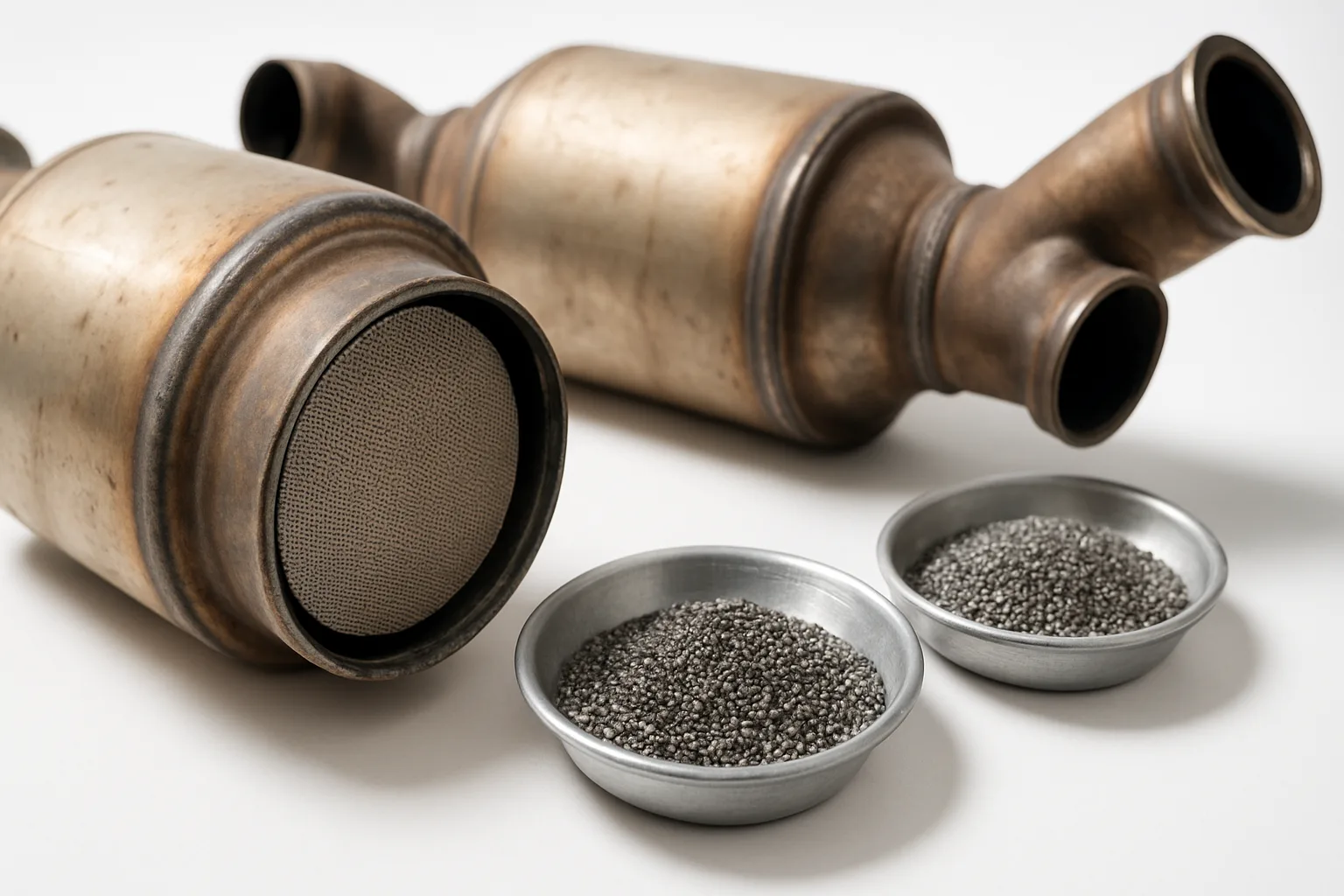
- Decanning — The steel shell gets cut away. What's left is the substrate — the honeycomb material where the platinum group metals (PGMs) are actually embedded.
- Milling/grinding — The substrate is crushed into a fine powder. This ensures even distribution of PGMs throughout the sample.
- Sampling — A representative sample is pulled from the milled material. This is the assay sample. Everything downstream depends on how accurately this step is done.
- Smelting — The bulk material gets smelted. High heat separates the PGMs from the ceramic or metallic substrate, concentrating them into a recoverable form.
- Assaying/fire assay or ICP analysis — The sample gets tested for exact concentrations of platinum, palladium, and rhodium. This is the data that drives your settlement number.
- Settlement — You get paid based on recovered weight of each metal multiplied by the spot price on settlement day, minus the refinery's processing fees and payability percentage.
Every step in that chain introduces variables. The accuracy of the sample. The efficiency of the smelt. The spot prices at settlement. Understanding this is how you stop treating your scrap cat value as a black box.
The Assay Process: Where Your Price Actually Gets Locked In
Assaying is the scientific determination of how much platinum, palladium, and rhodium your material contains. It's not an estimate. It's lab-grade analysis, and it's the foundation of every legitimate OEM catalytic converter value calculation.
There are two primary methods used in the industry:
Fire Assay (FA): One of the oldest metallurgical techniques still in active use. The milled sample gets mixed with lead oxide and flux, then melted in a furnace. The lead captures the PGMs and sinks to the bottom as a bead. That bead gets processed further to isolate and weigh each metal. Fire assay is reliable but slower.
Inductively Coupled Plasma (ICP) Spectrometry: The dissolved sample gets passed through a plasma torch. Each element emits a specific wavelength of light when ionized. The spectrometer measures those wavelengths and calculates exact concentrations. ICP is faster, highly accurate, and the dominant method at larger refineries today.
What the assay tells the refinery — and ultimately you — is the parts per million (PPM) of each PGM in your material. A ceramic cat from a domestic passenger vehicle might carry 1,000–2,000 PPM combined PGMs. A diesel unit might be considerably lower. A high-grade foil unit from a performance vehicle could push above that range. These aren't numbers to memorize — they vary by make, model, and substrate condition — but knowing PPM exists as a concept helps you understand why two cats that look identical can have very different values.
Why the Rhodium Price Today Changes Everything
Platinum and palladium get more media attention, but rhodium is the wildcard in catalytic converter scrap pricing. It's the rarest of the three PGMs, found in far lower concentrations — but its spot price can dramatically outpace the others depending on market conditions.
When the rhodium price today spikes, even a small PPM difference in your load becomes significant at scale. A yard moving hundreds of units a month feels every major rhodium move. A seller with a single high-grade cat feels it too — they just might not realize it if they accepted a flat quote without checking current spot prices.
This is exactly why settlement-based purchasing (where you get paid after assay results come back) generally delivers better price discovery than an upfront flat quote. Flat quotes protect the buyer from market movement. Settlement protects the seller — if prices rise between pickup and settlement, you benefit. If they fall, you're exposed. Understanding that trade-off is part of managing your scrap cat value seriously.
For yards in Florida and especially sellers navigating Tampa scrap metal services, knowing how to read current PGM spot prices — and timing your sales accordingly — is a real competitive edge. Most sellers don't bother. That's your opportunity.
OEM Catalytic Converter Value vs. Aftermarket: What the Smelter Sees
Not all cats smelt equal. The distinction between OEM (original equipment manufacturer) and aftermarket converters matters enormously to a refinery — and it should matter to you when you're quoting a load.
OEM converters are built to meet strict emissions standards. They carry meaningful PGM loadings because they have to perform under real-world engine conditions for years. These are the units that drive genuine OEM catalytic converter value and command serious attention from buyers.
Aftermarket converters — particularly budget replacements — often carry significantly lower PGM loadings. Some use alternative catalyst formulations. A refinery running ICP on an aftermarket unit will see lower PPM across the board. Buyers know this. If you're mixing OEM and aftermarket units in a load without disclosure, expect your blended average to come back lower.
Diesel particulate filters (DPFs) are a separate category entirely. They're large, heavy, and carry different metal profiles than traditional three-way converters. They should always be quoted and processed separately.
Knowing what you have before you sell is how you get a fair price for your scrap catalytic converters instead of getting averaged down on a mixed load.
How to Use Assay Knowledge to Sell Smarter — Especially in Florida
Understanding the science is only useful if it changes how you operate. Here's how to apply this practically:
- Sort before you sell. Separate foil, ceramic, and diesel units. Don't let a buyer lump everything together at a lower blended rate. Each category has its own value profile.
- Photograph and document your load. Serial numbers, VIN-based lookups, and photo documentation give buyers more confidence in what they're bidding on. More confidence means stronger offers.
- Check the rhodium price today before you accept any quote. If PGM prices are elevated, a flat quote may be leaving money behind. Settlement-based purchasing may serve you better.
- Use competitive buyer markets. A single phone call to a single buyer is not price discovery. Platforms like SMASH let you find the best price for your scrap on SMASH by putting your load in front of vetted buyers competing for it.
- Ask about payability percentages. Every refinery pays a percentage of the recovered metal value — not 100%. Typical payability ranges vary by processor and contract. A buyer offering 85% payability on a high-rhodium load is worth more than one offering 90% on a lower-value load. Do the math.
Tampa and the broader Florida market see consistent converter volume from auto salvage, fleet operations, and independent mechanics. That volume creates opportunity — but only if sellers are informed enough to capture it. Too many loads in this region move at prices set entirely by the buyer's margin. That's fixable.
Platforms like SMASH change that equation. No subscription fees. No guessing. Vetted buyers, auction format, and the kind of transparency that comes from documented inventory and competitive bidding. If you're serious about getting top dollar on your cats, you need more than one buyer at the table. You need to read scrap catalytic converter guides and come prepared.
The process from decanning to settlement isn't magic. It's metallurgy, lab science, and market pricing. Now you know how it works. Use it.
If you're ready to stop guessing and start selling with real data behind you, find the best scrap cat prices — get a free quote at best-scrap-cat-prices.com and see what competitive buyers will actually pay for your load.
Frequently Asked Questions
Q: How does the rhodium price today affect what I get paid for my scrap catalytic converter?
Rhodium is one of three precious metals recovered from catalytic converters, alongside platinum and palladium. Even though rhodium appears in lower concentrations, its spot price can be significantly higher than the other PGMs — meaning a strong rhodium price today can meaningfully increase the settlement value of your cats. Always check current PGM spot prices before accepting a flat quote.
Q: What is the difference between an assay and a smelter quote?
A smelter quote is the buyer's estimate of what your material is worth before processing. An assay is the lab result after your material has been milled, sampled, and tested — it shows the actual parts per million of platinum, palladium, and rhodium recovered. Settlement-based deals pay you based on assay results, not estimates, which can result in more accurate pricing for your load.
Q: Where can I sell catalytic converters in Tampa, Florida?
Tampa has active scrap metal buyers and recyclers who purchase catalytic converters, but pricing varies widely between buyers. For sellers in Tampa and across Florida, using a competitive platform like SMASH gives you access to multiple vetted buyers bidding on your load — which creates real price discovery instead of a single take-it-or-leave-it offer. You can also explore dedicated Tampa scrap metal services for local options.
Q: How accurate is a catalytic converter price list or online calculator?
Online calculators and price lists give you a ballpark based on make, model, and current PGM spot prices — they're useful for setting expectations, but they're not a settlement. Actual recovered value depends on the condition of your converter, the accuracy of the assay sample, and the payability percentage your buyer applies. Use calculators as a reference, not a guarantee.
Q: Does it matter if my catalytic converters are OEM or aftermarket when I sell them?
Yes — significantly. OEM catalytic converters carry higher PGM loadings and deliver stronger assay results than most aftermarket replacements. Buyers and refineries know the difference. If you mix OEM and aftermarket units in the same load without disclosing it, your blended PPM comes back lower and your overall settlement drops. Sort and identify your inventory before selling to protect your return.
``` --- *Stay ahead of scrap metal market moves — follow SMASH on LinkedIn at [linkedin.com/company/scrap-metal-auction-sales-hub](https://www.linkedin.com/company/scrap-metal-auction-sales-hub) for industry updates, pricing insights, and platform news.*