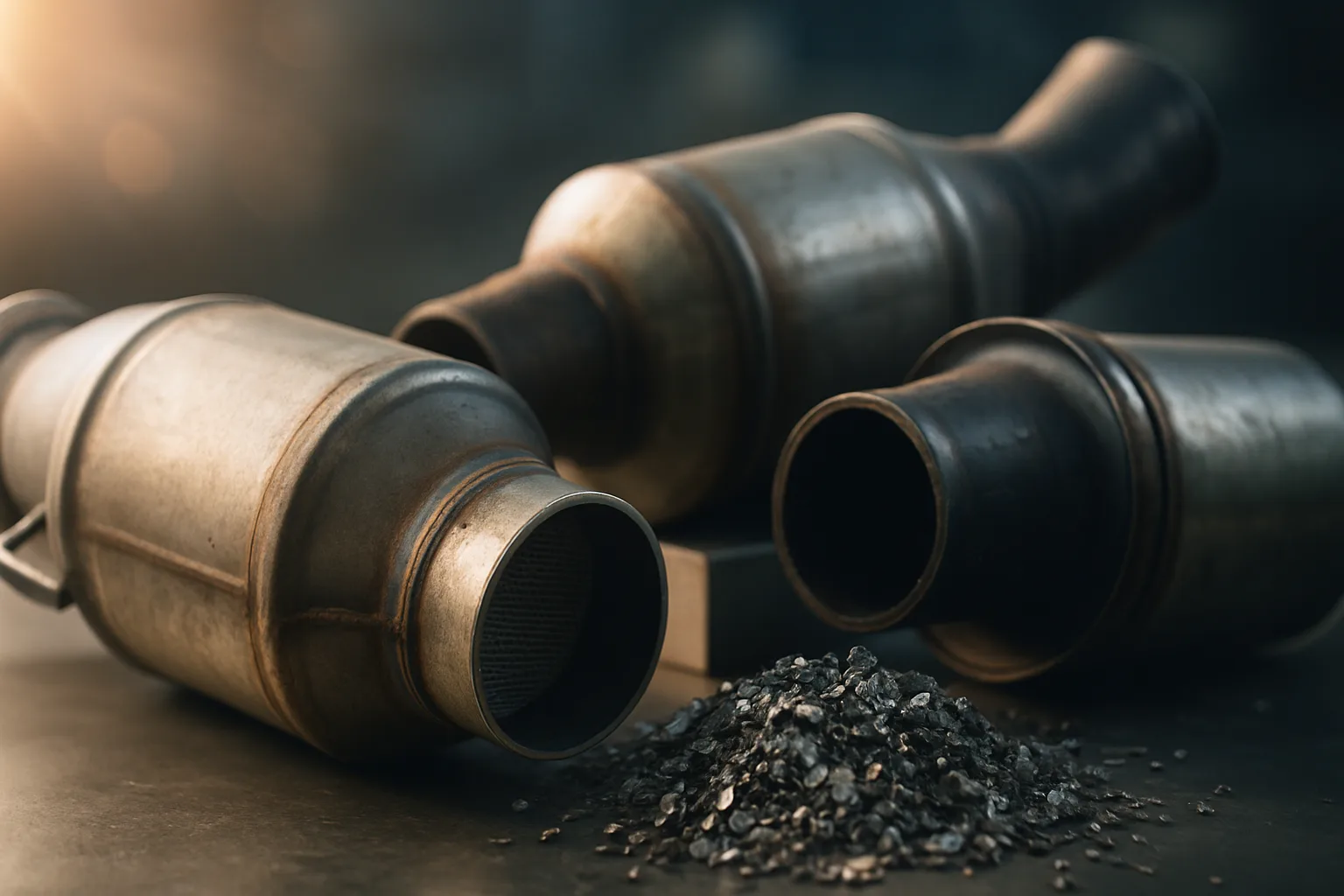
OEM vs. Aftermarket Catalytic Converters: Why the Scrap Value Gap Is Bigger Than You Think
Hand a yard operator two catalytic converters from the same vehicle year and model, and they might offer you wildly different prices. Same car. Completely different payouts. If that's ever happened to you, the answer almost always comes down to one thing: OEM versus aftermarket construction. Understanding that difference is the fastest way to stop leaving money on the table when you find the best scrap cat prices today.
The catalytic converter scrap value isn't arbitrary. It tracks directly to the precious metal content locked inside the substrate — platinum, palladium, and rhodium. OEM converters are engineered to meet strict emissions standards over the full life of a vehicle, which means manufacturers load them with meaningful concentrations of these metals. Aftermarket replacements are built to a price point. That changes everything downstream when it's time to scrap.
What's Actually Inside a Catalytic Converter — And Why It Matters for Scrap Cat Value
The washcoat is where the value lives. That's the ceramic or metalite substrate coated with platinum group metals (PGMs) — platinum, palladium, and rhodium. These metals catalyze the chemical reaction that converts exhaust toxins into less harmful compounds. The more PGMs per gram of substrate, the higher the catalytic converter scrap value when it hits a smelter.
OEM converters — the ones installed at the factory or by the vehicle manufacturer's certified supply chain — are spec'd to last 100,000 to 150,000 miles under real-world conditions. To do that, they carry a denser PGM loading. An aftermarket unit only needs to pass an emissions test and hold up long enough to avoid a warranty return. Engineers can hit that bar with significantly less precious metal content.
Here's what that means in practice:
- OEM substrate: Higher PGM concentration per unit of substrate weight
- Aftermarket substrate: Lower PGM loading, sometimes dramatically so
- OEM housing: Often thicker steel, heavier overall unit
- Aftermarket housing: Lighter gauge steel, smaller substrate volume in many cases
- Net result: OEM units routinely yield more at assay, which is why buyers bid them differently
This isn't speculation. Smelters and processors assay every load. The bid you get reflects what a buyer expects to recover. A vetted cat converter buyer isn't guessing — they're working from grade data built on thousands of previously processed units.
How Palladium Price Today Amplifies the OEM vs. Aftermarket Gap
The precious metals market makes the spread between OEM and aftermarket scrap values a moving target. Palladium in particular has been a major driver of catalytic converter scrap value over recent years, and while markets fluctuate — always check current rates before you sell — understanding the mechanics helps you time and position your loads better.
Palladium is the primary PGM in gasoline engine converters. Platinum dominates diesel applications. Rhodium commands extreme value in small quantities and is present in most three-way converters. When palladium price today is elevated, the gap between a high-PGM OEM unit and a low-PGM aftermarket unit widens in raw dollar terms. A 10% difference in PGM loading becomes a larger dollar spread at $1,800/troy oz than at $900/troy oz.
This is why a converter that felt worthless in a flat market can suddenly generate serious interest. It's also why sorting your inventory matters. Mixing OEM and aftermarket units in the same lot without disclosure leaves a buyer to price the whole load to the lower-value common denominator. Separation and documentation consistently produce better price discovery.
Disclaimer: Precious metal prices fluctuate daily based on global market conditions. Always verify current palladium, platinum, and rhodium spot prices before selling. The figures referenced here are illustrative only.
Identifying OEM vs. Aftermarket Before You Sell — Practical Steps for Los Angeles Sellers
If you're pulling cats in Los Angeles or anywhere across California, you're working with a high-volume, high-diversity stream. The LA market sees everything — imports, domestics, fleet vehicles, older trucks, hybrids. Knowing how to sort before you call a buyer separates a rough quote from a real one.
Here's how to tell OEM from aftermarket in the field:
- Check the stamp. OEM units often carry the vehicle manufacturer's part number or a supplier code (Denso, Tenneco, BASF Catalysts). Aftermarket units may be stamped with brands like MagnaFlow, Walker, or Eastern, or carry a generic code.
- Look at the weld quality and housing. OEM units are generally cleaner, heavier, and better finished. Aftermarket units often have lighter housings and visible cost-cutting in construction.
- Substrate volume matters. Cut one open if you're processing at volume. Larger substrate = more washcoat = more PGM potential. Aftermarket units often use a smaller substrate in a larger housing.
- Serial number and VIN matching. Platforms with VIN lookup capabilities can confirm whether a converter matches the vehicle's original equipment spec — useful for higher-value units.
- Weight comparison. OEM units tend to run heavier for the same application. A noticeably light converter is often aftermarket.
For Los Angeles scrap metal services, sorting this inventory before you list or call a buyer means you walk in with a stronger position. You're not asking a buyer to sort your mess — you're presenting a documented, graded load. That changes the conversation.
If you want to get a fair price for your scrap catalytic converters, the work you do on the sorting floor before the sale directly impacts what you receive. This is true whether you're selling five cats or five hundred.
Why Selling Scrap Catalytic Converters Online Beats the One-Buyer Phone Call
The traditional way to sell catalytic converters is still painfully common: you pull the cats, you call one buyer, you take whatever they say. Maybe you call a second buyer to sanity-check the number. That's not price discovery — that's guessing with extra steps.
The better approach is competition. When multiple vetted buyers see your documented inventory at the same time, they bid against each other. The market sets the price, not one buyer's margin targets. This is exactly what platforms like SMASH are built for.
SMASH runs a competitive auction format that puts your scrap cat inventory in front of verified buyers simultaneously. Instead of one cold call and a take-it-or-leave-it offer, you get real market data. More buyers means better price discovery. Documented inventory — photos, serial tracking, weight, grade — gives buyers more confidence to bid aggressively. That confidence shows up in your payout.
You can compare scrap metal bids from verified buyers and see the difference between the old way and a competitive process. For sellers in California processing significant cat volume, this isn't a minor upgrade. It's a fundamentally different result.
There are no subscription fees with SMASH. The model is simple: SMASH only wins when you win. That alignment matters when you're deciding who handles your loads.
What to Document Before You List Your Cats — Especially for High-Value OEM Loads
Documentation is the unsexy part of getting top scrap cat prices. It's also the part that separates a vague offer from a competitive one. Buyers who can see what they're buying bid differently than buyers who are guessing. This is true in Los Angeles, in California broadly, and across every major market in North America.
Before you list a load of catalytic converters — especially if it contains OEM units you believe carry strong PGM content — gather the following:
- Clear photos of each unit, including stamps, serial numbers, and substrate condition
- Weight per unit or total lot weight, separated by grade where possible
- Source vehicle data if available — year, make, model, engine size helps buyers confirm OEM grade
- Condition notes — cracked substrate, damaged housing, or foiled units should be disclosed; hiding it destroys trust and kills repeat business
- Separation by grade — don't mix your large domestic OEM units with small import aftermarkets and expect a blended price that rewards your best material
Platforms like SMASH support photo documentation and serial tracking built into the listing process. That infrastructure exists because documented loads consistently generate stronger buyer engagement. Want to read scrap catalytic converter guides on maximizing what you document and why it matters? There's more depth available on every part of the selling process.
The secondary keyword sell catalytic converters California comes up constantly in searches because California sellers are dealing with both high volume and high regulatory scrutiny. Documentation isn't just good sales strategy in California — it's increasingly a compliance requirement under California's catalytic converter theft laws. Keep records. They protect you and they make your loads more sellable.
Frequently Asked Questions
Q: How do I know if my catalytic converter is OEM or aftermarket?
Look for manufacturer part numbers or OEM supplier stamps (Denso, BASF, Tenneco) on the housing. Aftermarket units are often stamped with brands like Walker, MagnaFlow, or Eastern. OEM units also tend to be heavier and better constructed than aftermarket replacements. When in doubt, the vehicle's year, make, model, and VIN can help confirm what the original equipment spec should be.
Q: Why is the scrap value difference between OEM and aftermarket so large?
The value gap comes down to precious metal content. OEM converters carry higher platinum group metal (PGM) loadings because they're engineered for long-term emissions compliance. Aftermarket units are built to meet minimum emissions standards at a lower cost, which means less palladium, platinum, and rhodium per unit — and significantly lower catalytic converter scrap value at assay.
Q: Does palladium price today affect what I get for my scrap cats?
Absolutely. Palladium is the dominant PGM in gasoline engine catalytic converters, so when palladium prices are elevated, high-PGM OEM units become more valuable in dollar terms. The spread between OEM and aftermarket values also widens when precious metals are trading high. Always check current spot prices before selling, as markets move daily.
Q: Where can I sell catalytic converters for cash in Los Angeles?
Los Angeles has a dense network of scrap yards and cat buyers, but getting the best price means going beyond your nearest yard. Using a competitive platform like SMASH puts your inventory in front of multiple vetted buyers at once, which produces better price discovery than a single call to one local buyer. For Los Angeles scrap metal services and converter buying, comparing multiple bids is always the stronger move.
Q: Do I need to separate OEM and aftermarket cats before selling?
Yes — if you want the best return on your OEM material, separate it. Mixing high-value OEM units with low-value aftermarket units in a single lot forces buyers to price the whole load conservatively. Sorting by grade takes time, but it consistently produces stronger offers on your premium material. Document and photograph each grade separately before you list.
You've pulled the cats, now get paid what they're actually worth. The OEM units in your inventory carry real precious metal value — don't let them get lumped into a generic lot and priced to the bottom. Sort, document, and put your load in front of real competition. SMASH gives you that competitive process with no subscription fees and no guesswork. Ready to stop taking the first number you hear? Find the best scrap cat prices — get a free quote at best-scrap-cat-prices.com.
Stay sharp on market moves and scrap metal trends — follow SMASH on LinkedIn for industry updates, precious metal market insights, and practical selling strategies built for real yard operators.