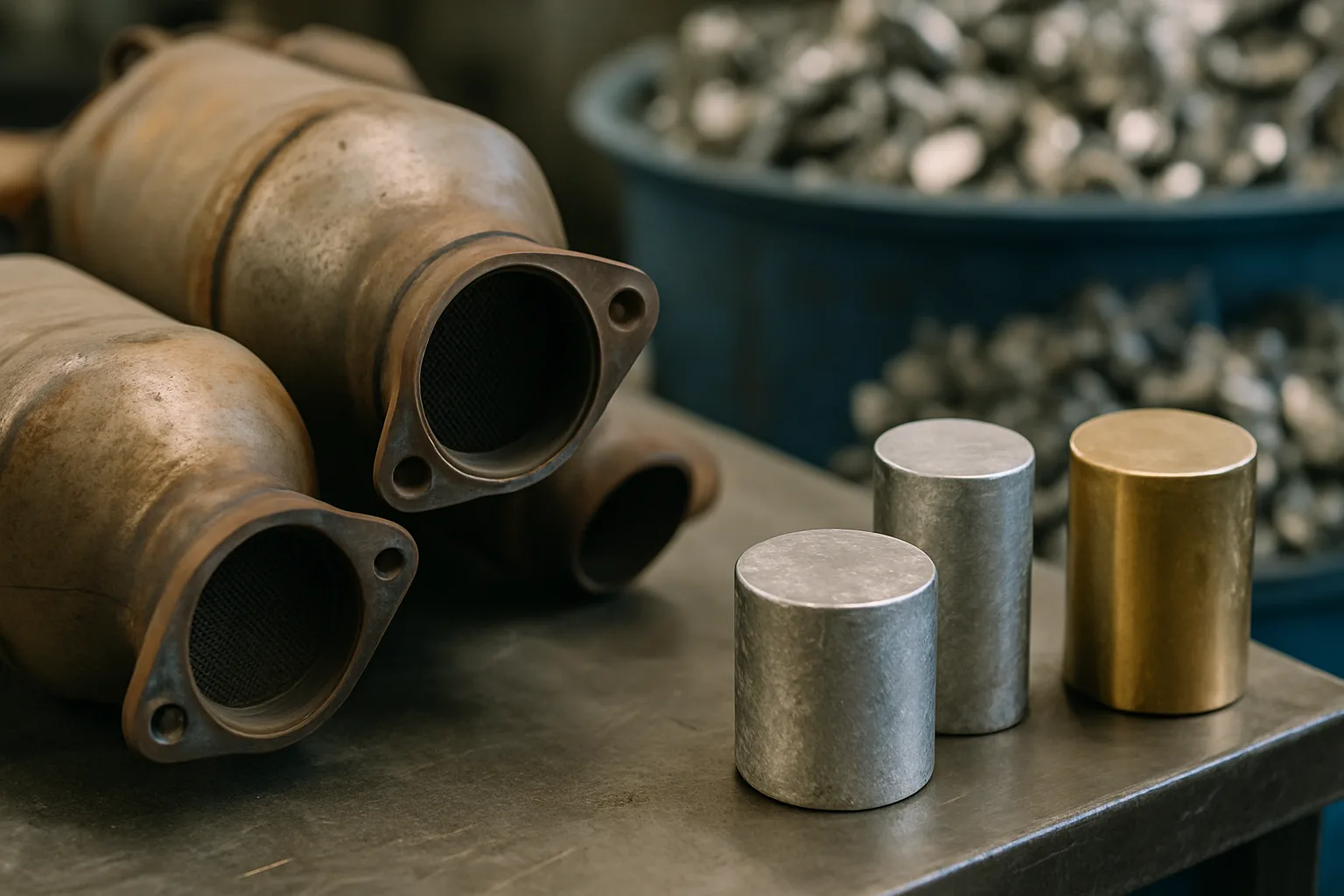
What's Actually Inside Your Catalytic Converter — And Why It Matters for Your Payout
Most scrap yards will hand you a number without explaining it. That number isn't random — it's built on three precious metals locked inside your converter, each with its own live market price. If you want to sell catalytic converters online and actually understand what you're getting, you need to know what drives that price before you pick up the phone.
Platinum, palladium, and rhodium. Those three metals determine almost everything. The ceramic honeycomb inside your cat is coated with a precise mix of them, and their spot prices move every single trading day. A converter worth $180 on Monday might quote differently by Friday — not because anything changed about the part, but because commodity markets moved.
This guide breaks down how each metal affects your payout, what the assay process looks like, and how platforms like SMASH connect you with competitive buyers who actually compete for your load — instead of just quoting you whatever they feel like.
Platinum, Palladium, and Rhodium: The Three Metals Setting Your Scrap Cat Value
Every catalytic converter uses a washcoat — a thin ceramic layer bonded to the substrate — that contains these three platinum group metals (PGMs). The exact mix depends on the vehicle type, engine, manufacturer, and model year. A late-model domestic truck converter looks very different from a European diesel unit or a hybrid cat on the inside, even if they're the same physical size.
Here's a quick breakdown of each metal's role:
- Platinum (Pt): Historically the dominant PGM in catalytic converters. Used heavily in diesel converters. Prices fluctuate based on industrial demand, automotive production volumes, and investment flows. It's typically the most stable of the three, but "stable" in commodities is relative.
- Palladium (Pd): Took over from platinum in most gasoline converters through the 2000s and 2010s as automakers shifted formulations. Palladium saw dramatic price swings in prior years and remains sensitive to auto sector news, Russian supply dynamics, and EV adoption rates.
- Rhodium (Rh): The wildcard. Rhodium is produced in tiny quantities — mostly as a byproduct of platinum and palladium mining — and it has seen extreme price volatility. When rhodium runs high, converters that were written off as low-value can suddenly be worth serious money. When it drops, the reverse is true.
The ratio of these three metals inside your specific converter determines its base value before anything else is factored in. That's why a "good" price for one part number might be a bad deal for another. Generic quotes without knowing your serial number or part are exactly that — generic.
How the Assay Process Translates Metal Content into an Actual Dollar Amount
When a professional cat converter buyer quotes your scrap, they're working from assay data. An assay is a chemical or spectroscopic analysis of the substrate that measures the exact concentration of each PGM per unit of material. Serious buyers maintain databases of thousands of part numbers, each tied to an average assay result from previous testing.
The math works roughly like this:
- Identify the part — by serial number, OEM code, or visual match against a catalytic converter price list database.
- Pull the assay — the database returns the average PGM loadings (in troy ounces per unit) for that part.
- Apply current spot prices — multiply each metal's loading by today's market price for platinum, palladium, and rhodium.
- Apply a recovery percentage — processors don't recover 100% of the metal. They typically factor in a smelting recovery rate, commonly ranging from the high 70s to mid-80s depending on the processor and material quality.
- Subtract processing and margin — the buyer takes their cut. What's left is your offer.
The problem with the traditional single-buyer phone call is that you have no visibility into steps 3 through 5. You're told a number and expected to accept it. Competition changes that equation entirely. When multiple vetted buyers bid on your inventory, the margin compression works in your favor — not theirs.
Want to find the best scrap cat prices today? The first step is understanding that "best price" isn't a fixed number. It's what the market reveals when real buyers compete.
Why Scrap Cat Prices in Grand Rapids Can Vary More Than You Expect
If you're selling catalytic converters in Grand Rapids, Michigan, you're operating in a market with serious volume. West Michigan has a dense manufacturing base, a strong automotive aftermarket sector, and a regional recycling infrastructure that feeds larger processors. That means buyers are active here — but it also means local pricing can diverge significantly depending on who you call and when.
A local yard might quote based on a flat-rate price list updated weekly. An online buyer might quote based on live spot prices updated daily. A national processor working through an auction platform might pay more because they're competing against four other bidders for your load. Grand Rapids sellers who stick to one local relationship often leave money on the table — not because the local yard is dishonest, but because there's no competitive pressure on their end.
Michigan sellers also benefit from being within reasonable freight range of multiple processing hubs in the Midwest. That geographic advantage matters when you're putting converters on an auction platform — more processors can realistically bid on your load, which deepens the buyer pool and improves price discovery.
If you're managing multiple lots or want to understand how different parts are valued before listing, read scrap catalytic converter guides that break down what to expect by converter type and market conditions.
Scrap Metal Inventory Management: Why Documentation Drives Better Offers
Here's something most sellers overlook: how you present your inventory directly affects what buyers are willing to pay. A disorganized lot with no photos, no serial numbers, and no part identification is a liability for a buyer. They're pricing in uncertainty. You get a low offer not because your converters are bad — but because the buyer doesn't know that.
Strong scrap metal inventory management means documenting what you have before it goes to market. That includes:
- Photographing each converter clearly — top, bottom, and substrate if visible
- Recording serial numbers or OEM codes where stamped or engraved
- Noting condition — intact substrate, cracked, rattled out, or aftermarket foil-type
- Separating high-value units (large domestics, late-model foreign, diesel trucks) from low-value units
- Keeping an accurate count with weights where possible
This isn't just organizational housekeeping — it's a pricing tool. Documented inventory gives buyers more confidence. More confidence means less risk discount in their bid. SMASH's platform is built around this exact principle: serial tracking, photo documentation, and VIN lookup tools that turn a "box of cats" into a verified, itemized lot that serious buyers can evaluate and bid on competitively.
For Grand Rapids yards processing significant weekly volume, the difference between loose unsorted inventory and a properly documented lot can be meaningful at scale. Better documentation compounds over time.
How SMASH Helps You Sell Catalytic Converters Online Without Guessing at Your Price
The old way: call one buyer, get one number, decide whether to take it or leave it. No context. No comparison. No way to know if that number reflects today's platinum price or last month's.
SMASH changes the dynamic. Instead of one call, your documented lot goes in front of vetted buyers across North America who compete in a structured auction format. The auction format does what phone calls can't — it creates actual market competition on your specific inventory, on the day you're selling it, at current PGM spot prices.
There's no subscription fee. SMASH only wins when the seller wins. That alignment matters. It means the platform has a direct incentive to get your lot in front of the right buyers and to make the process clean — accurate documentation, auto-invoicing, proper paperwork including BOLs and packing lists.
Whether you're a Grand Rapids yard moving a few dozen cats a week or a larger operation managing hundreds of units, platforms like sell your scrap metal on the SMASH marketplace are built to replace the guesswork with actual market data.
More buyers means better price discovery. That's not a slogan — it's how auctions work.
Getting the Best Scrap Cat Price: Practical Steps Before You List
Before you put your converters on the market — whether through an online platform or a local buyer — a few preparation steps will consistently improve your outcome:
- Identify what you have. Sort your load by converter type. Large domestic units, foreign small cars, diesel trucks, and aftermarket parts all carry different values. Don't let a buyer average down your premium units.
- Check live PGM spot prices. The platinum price today, along with palladium and rhodium, is publicly available through commodity exchanges and precious metals feeds. Understanding the market direction before you list helps you evaluate offers intelligently.
- Document before you ship. Photos and serial records protect you legally and commercially. A buyer who later claims a substrate was cracked can't argue against timestamped photos.
- Use a competitive platform. Single-buyer quotes have no built-in pressure. Auctions do. The format matters.
- Understand the recovery math. Ask any buyer what recovery percentage they use in their pricing. A higher offer at a lower recovery rate may pay less than a slightly lower offer at a higher rate.
If you're ready to stop guessing and start getting competitive bids, get a fair price for your scrap catalytic converters through a process built on transparency — not whoever picks up the phone first.
Disclaimer: Catalytic converter prices fluctuate daily based on live PGM spot markets. All values referenced are for general informational purposes only. Always verify current rates before making selling decisions.
Frequently Asked Questions
Q: How do I sell catalytic converters online safely?
Use a platform that vets its buyers and provides documentation tools — photo records, serial tracking, and proper paperwork like BOLs. Avoid unsolicited buyers with no verifiable business history. Platforms like SMASH require buyer vetting before anyone can bid on your load, which reduces your exposure to bad actors significantly.
Q: What affects scrap cat prices the most — platinum, palladium, or rhodium?
It depends on the converter type. Diesel converters carry higher platinum content. Gasoline converters lean more on palladium. Rhodium affects all types and can swing dramatically based on supply constraints. Check live PGM spot prices before listing — all three metals move independently.
Q: Where can I sell catalytic converters in Grand Rapids, Michigan?
Grand Rapids has local scrap yards that buy converters, but local-only selling limits your buyer pool. Listing your inventory through an online auction platform means buyers from across North America compete for your load — not just whoever is within driving distance in Michigan. Competition typically improves price discovery.
Q: Why do prices vary so much between buyers?
Different buyers use different assay databases, different recovery percentages, and different margin structures. Some update pricing daily against live spot prices; others use weekly flat-rate lists. The spread between the lowest and highest offer on the same lot can be significant — which is exactly why competitive bidding formats exist.
Q: Does documentation really affect what I get paid for my scrap cats?
Yes, directly. Undocumented lots force buyers to price in uncertainty, which means lower bids. A properly documented lot — photos, serial numbers, condition notes — reduces buyer risk and supports more confident, competitive offers. Documented inventory gives buyers more confidence, and that confidence shows up in their bids.
If you're selling scrap catalytic converters in Grand Rapids or anywhere across Michigan, don't leave your payout to a single cold call. Understand your metal content, document your inventory, and put it in front of a competitive buyer pool. When you're ready, find the best scrap cat prices — get a free quote at best-scrap-cat-prices.com.
Follow SMASH on LinkedIn for ongoing scrap metal market insights, PGM price updates, and industry news that helps you sell smarter.