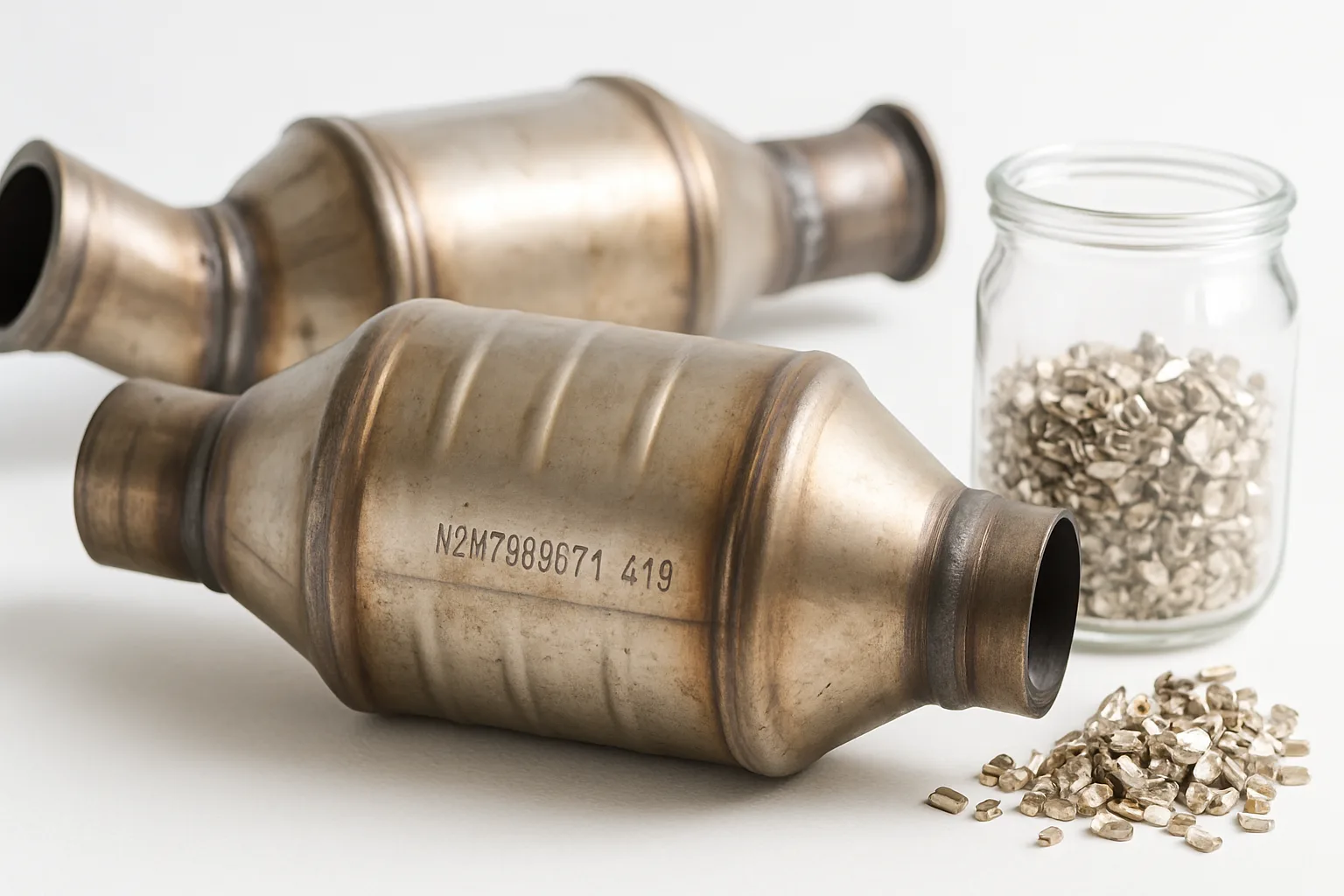
The serial number stamped on your catalytic converter is worth more than you think — not just as an identifier, but as a direct line to its precious metal value. If you're trying to sell catalytic converters online and getting lowball offers, there's a good chance you're not using that serial number to your advantage.
Buyers price cats based on what's inside: platinum, palladium, and rhodium — the platinum group metals (PGMs) that make a converter worth anything at all. The serial number is the key that unlocks that data. Read it wrong, skip it entirely, or hand it to the wrong buyer, and you leave real money on the table.
This guide breaks down exactly how to find, read, and use catalytic converter serial numbers so you can find the best scrap cat prices today — whether you're clearing a single unit or moving a full load.
Why the Serial Number Controls Your Scrap Cat Value
Every catalytic converter contains a ceramic or metallic substrate coated with PGMs. The amount of platinum, palladium, and rhodium varies dramatically between makes, models, model years, and even production runs. A serial number tells a trained buyer exactly which substrate they're looking at — and therefore, what it should pay.
Without a serial number, buyers guess. And when buyers guess, they guess low. That's not a coincidence — it's a margin strategy. The buyer absorbs the uncertainty and prices it into their offer. You pay for that uncertainty with a worse deal. With a confirmed serial number tied to a known assay, the conversation changes. You're not asking what someone will give you. You're confirming what the metal is actually worth based on platinum group metals recycling data.
In 2026, PGM market volatility is still a factor. The platinum price today fluctuates alongside palladium and rhodium, which means even identical converters can fetch different prices week to week. A documented serial number lets you anchor your price to real data — not a buyer's mood or a slow afternoon.
Where to Find the Serial Number on a Catalytic Converter
Serial numbers aren't always obvious. Location and format vary by manufacturer, and some cats have multiple codes stamped in different spots. Here's where to look:
- Direct stamp on the shell: Most OEM converters have a number stamped directly into the metal housing. Look along the seam, near the inlet or outlet pipe, or on a flat face of the body.
- Welded-on tag or plate: Some manufacturers attach a small metal tag. These can corrode or fall off over time, which is why photo documentation matters.
- Heat shield sticker or label: Less common, but some units carry a printed label under the heat shield. Check before you cut anything.
- OEM casting codes: Older converters may have a casting code rather than a traditional serial. These still map to substrate data if you know where to look.
- VIN-linked numbers: On some vehicles, particularly European makes, the converter serial ties back to the vehicle's VIN. This is where a VIN lookup tool becomes useful.
Clean the area before you read it. Dirt, rust, and grease obscure digits fast. A wire brush and a few seconds of prep can be the difference between a readable number and a guess. Take a photo immediately — good light, sharp focus, nothing cropped. That image becomes part of your documentation and protects you in any dispute.
How to Decode What the Serial Number Actually Means
Serial numbers on catalytic converters aren't standardized across the industry. Each manufacturer uses its own format. That said, there are common patterns worth understanding:
- OEM part numbers: These follow the original equipment manufacturer's part numbering system. A Ford cat serial will look different from a Toyota or BMW unit. Cross-referencing with a reliable cat converter buyer database or pricing tool maps these to known PGM loads.
- Aftermarket codes: Aftermarket converters — Walker, Magnaflow, Eastern, and others — use their own numbering. Aftermarket cats generally carry lower PGM content than OEM units. Don't assume an aftermarket unit is worth what an OEM looks like from the outside.
- Foreign direct reduction (FDR) or small domestic (SD) codes: These classification terms appear in some buyer databases. They describe the general category and expected metal load. Knowing which category your unit falls into helps set price expectations before you talk to anyone.
- Alpha-numeric hybrids: Many codes combine letters and numbers. The letter prefix often identifies the manufacturer or platform. A "GP" prefix means something different than an "EC" or "XL" in a buyer's database.
You don't need to memorize all of this. You need to capture the number accurately and get it in front of a system or buyer who can run it properly. Platforms like SMASH, built for the B2B scrap metal marketplace, allow sellers to document and list inventory with serial tracking — so buyers are bidding on confirmed data, not assumptions. That's how you get real price discovery instead of a phone-call guess.
Common Mistakes That Kill Your Scrap Cat Price
Sellers in Las Vegas and across Nevada run into the same issues repeatedly. Most of them are avoidable once you know what to watch for.
- Misreading a digit: A "B" that looks like an "8," or a "0" instead of a "D" changes the entire price. Always double-check ambiguous characters against the photo.
- Photographing a dirty converter: Buyers can't verify what they can't read. Clean units get faster responses and better offers. This is especially true when you sell catalytic converters online — the photo is your handshake.
- Skipping serial documentation on high-value units: Exotic cats — certain Toyota, Honda, and luxury European units — can carry significant PGM loads. Skipping the serial on one of these to save five minutes is an expensive shortcut.
- Treating all aftermarket units as scrap filler: Some aftermarket cats do carry meaningful PGM content. Don't assume. Read the number. Run it.
- Not tracking which serial matched which vehicle: If you're pulling converters from a fleet or multiple vehicles, match each serial to a VIN before you mix them in a bin. Batch documentation pays off later.
If you're moving volume in Las Vegas, sloppy documentation compounds fast. Ten units with unverified serials is ten price guesses stacked on each other. A buyer using a find the best price for your scrap on SMASH model doesn't need to guess — they're bidding on documented inventory, which means the competition for your load is based on real data, not optimism.
Serial Numbers, Compliance, and What's Changed in 2026
Catalytic converter theft remains a serious issue across the U.S., and serial number documentation has become part of the compliance conversation in many states. Nevada has strengthened its requirements for scrap dealers and recyclers around documented sourcing of catalytic converters. If you're selling in Las Vegas or anywhere in Nevada, know that proper serial number records aren't just good business — they're increasingly a legal requirement for the businesses buying from you.
Reputable cat converter buyers now ask for serial documentation as part of intake. Any buyer who doesn't ask is either operating outside best practices or building risk into their offer (and yours). This is also why photo documentation at point of removal matters. A timestamped photo of the serial number, tied to a work order or VIN, creates a clean chain of custody that protects both seller and buyer.
For sellers who want to get a fair price for your scrap catalytic converters, the documentation standard has become a competitive advantage. Buyers compete harder for inventory they can verify. That's basic market logic — confirmed supply commands better pricing than uncertain supply.
The evolving regulatory environment also affects how processors handle PGM refining data. Assay transparency is increasingly expected at the refinery level, and that data flows back to buyers who use it to sharpen their bids. If you want to benefit from that transparency, your serial numbers need to be readable and recorded. Read scrap catalytic converter guides to stay current on documentation standards and best practices as the market evolves.
How to Use Serial Numbers to Get the Best Scrap Cat Price in Las Vegas
Here's the practical workflow that turns a serial number into a better offer:
- Remove and clean the converter. Brush off rust and grime. You need a readable surface.
- Locate all stamps and tags. Check the shell seam, inlet/outlet areas, heat shield underside, and any attached plates.
- Photograph everything. One shot of the full unit. One close-up of the serial. Good light, sharp focus. If it's blurry, shoot it again.
- Record the serial against the vehicle VIN. Even if you only have one unit, this habit protects you from compliance issues later.
- Run the serial through a pricing database or list it on a verified platform. Don't call one buyer and accept the first number you hear. Get competitive bids. The scrap cat value you walk away with should reflect what the PGMs are actually worth — not what one buyer decided to offer on a Tuesday.
- Compare offers and document the transaction. Keep records. Invoice, serial number, buyer, date, amount. Clean documentation is worth its weight in palladium.
If you're handling Las Vegas scrap metal services, this process scales. Whether you're a shop clearing five units a month or a yard moving loads, the serial number workflow is what separates guesswork pricing from market pricing. SMASH supports this workflow with inventory tools and serial tracking built for exactly this kind of volume — so competitive buyers are bidding on your documented inventory, not haggling over unknowns.
The best scrap cat price isn't handed to you. It comes from knowing what you have, proving it, and putting it in front of buyers who compete for it. Serial numbers make that possible. Don't skip the step that unlocks the value.
Ready to stop guessing and start selling on data? Find the best scrap cat prices today at best-scrap-cat-prices.com — get a free quote and see what your documented inventory is actually worth.
Disclaimer: Scrap catalytic converter prices fluctuate based on PGM spot prices, converter type, and market conditions. Always check current rates before selling. The platinum price today may differ from rates at time of publication.
Frequently Asked Questions
Q: Where is the serial number on a catalytic converter?
The serial number is typically stamped directly onto the converter's metal shell — check along the seam, near the inlet or outlet pipe, or on any flat face of the housing. Some units have a welded metal tag or a label under the heat shield. Clean the surface before reading it, and always photograph what you find.
Q: Can I sell catalytic converters online without the serial number?
You can try, but you'll likely get lower offers. When you sell catalytic converters online, buyers use the serial number to confirm PGM content and price accurately. Without it, they price conservatively to cover their uncertainty — and that difference comes out of your pocket. Document the serial before you list.
Q: Are there specific rules for selling scrap catalytic converters in Las Vegas or Nevada?
Yes. Nevada has strengthened regulations around catalytic converter recycling, including documentation requirements for scrap dealers. In Las Vegas, reputable buyers require proof of ownership or sourcing and serial number records as part of compliance. Sellers should keep records of where each converter came from and match serials to vehicle VINs where possible.
Q: How does the platinum price today affect my scrap cat value?
Directly. The PGMs inside your converter — platinum, palladium, and rhodium — are priced against live commodity markets. When platinum or palladium prices move, so does your cat's value. Checking current platinum group metals recycling market data before you sell helps you time offers and understand whether a bid is fair.
Q: What's the difference between OEM and aftermarket catalytic converter scrap prices?
OEM converters typically carry higher PGM loads than aftermarket units, which means they generally fetch better scrap prices. Aftermarket cats from brands like Walker or Magnaflow are manufactured to meet emissions standards at lower cost, which usually means less precious metal content. Always run the serial number — never assume an aftermarket unit is worth the same as an OEM just because it looks similar.
Follow SMASH on LinkedIn for industry updates, PGM market insights, and scrap metal news: linkedin.com/company/scrap-metal-auction-sales-hub
```