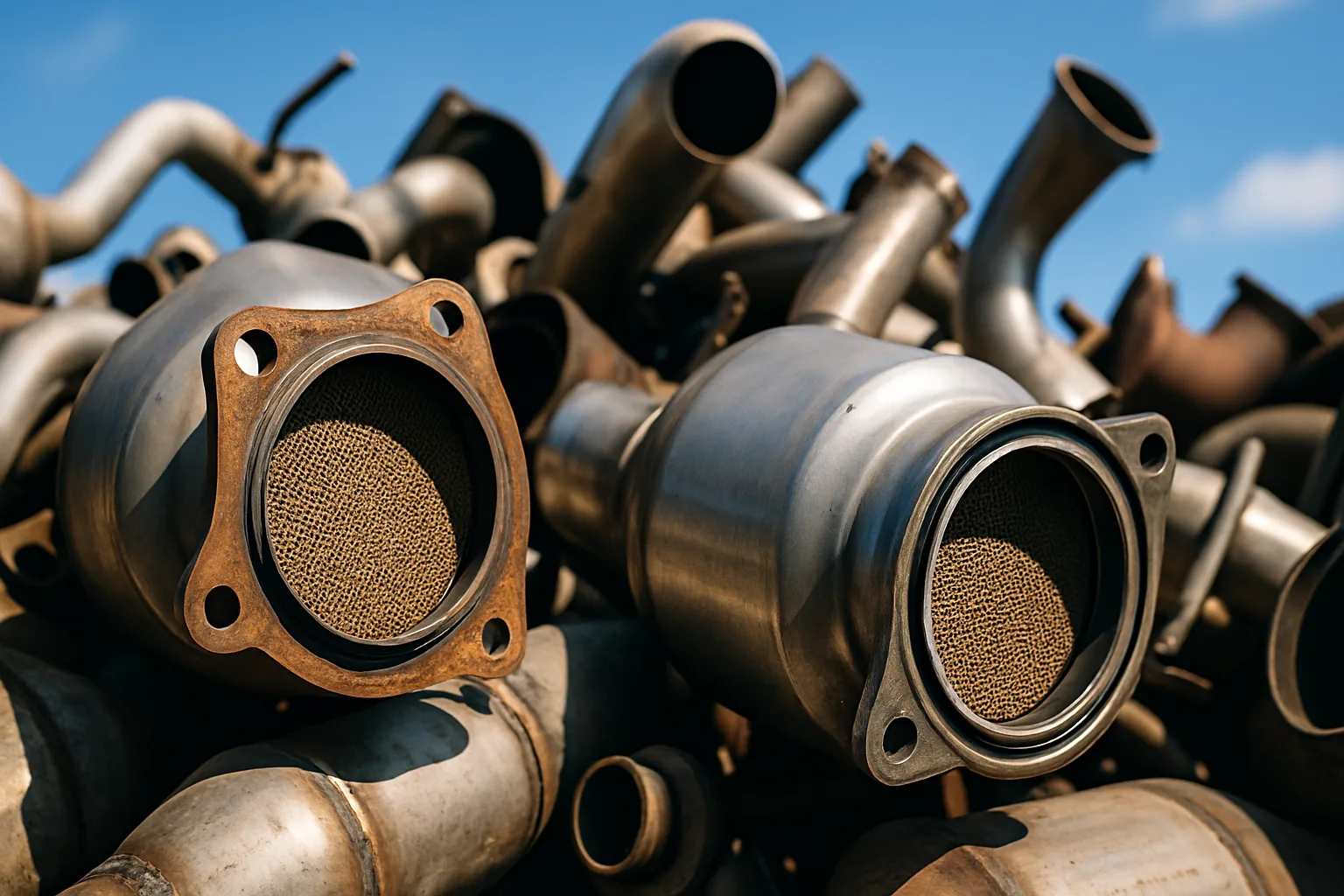
The platinum price today can swing by hundreds of dollars per troy ounce in a single week — and your catalytic converter's value moves with it. Most scrap yards don't advertise that. They quote you a flat number, pocket the spread, and move on. If you're sitting on a load of cats in Columbus or anywhere else in Ohio, understanding what actually drives the daily price is the difference between leaving money on the table and getting what your material is worth.
This isn't a theoretical exercise. Scrap cat prices fluctuate every business day based on precious metal markets. Palladium, rhodium, and platinum are the three metals inside every catalytic converter — and each one trades independently on global commodity exchanges. Your converter isn't just a piece of scrap. It's a small package of precious metals, and its value is live.
Let's break down how the daily market actually works, what moves the numbers, and how to use that knowledge to find the best scrap cat prices today before you sell.
The Three Metals That Set Your Catalytic Converter Scrap Price
Every catalytic converter contains a ceramic or metallic substrate coated with platinum group metals (PGMs). The three that matter for scrap value are platinum, palladium, and rhodium. Each one has its own market, its own supply chain, and its own price drivers. When any one of them moves, your cat's value moves too.
Here's a quick breakdown of what each metal does and why it matters:
- Platinum: Used heavily in diesel vehicle converters. The platinum price today is one of the most-searched benchmarks in the scrap cat industry. Platinum trades on the London Platinum and Palladium Market (LPPM) and is quoted in USD per troy ounce.
- Palladium: Found in most gasoline-engine converters. Palladium saw historic highs earlier in the decade and remains a significant value driver for high-volume cat sellers.
- Rhodium: The wildcard. Rhodium prices are highly volatile — they've traded anywhere from a few hundred to over twenty thousand dollars per troy ounce in recent years. Even tiny amounts of rhodium inside a converter can represent real money.
The concentration of each metal varies by vehicle make, model, year, and engine type. A converter from a late-model luxury SUV will carry a different PGM load than one from a compact economy car. This is exactly why serial number identification matters so much — and why a get a fair price for your scrap catalytic converters approach requires more than a phone call to a single buyer.
Why the Platinum Price Today Changes Your Payout — Every Single Day
Precious metal markets don't take days off. Platinum trades globally, and prices are updated throughout each trading session. By the time you call your local buyer in Columbus on a Tuesday afternoon, the market may have already moved from where it was Monday morning. Some buyers update their cat price lists daily. Others don't update for days — and the difference comes out of your check.
Several factors push the platinum price today up or down:
- Mining supply disruptions: South Africa and Russia account for the majority of global platinum and palladium production. Labor strikes, power outages, or geopolitical tension in those regions can tighten supply fast.
- Auto industry demand signals: Catalytic converters are the single largest industrial use of PGMs. Production data from major automakers and EV adoption trends both influence long-term demand expectations.
- Currency movements: Because PGMs are priced in USD, a stronger or weaker dollar affects purchasing power for international buyers and can shift global pricing dynamics.
- Speculative trading: Commodity funds and institutional traders move in and out of PGM positions. Short-term price swings don't always reflect fundamental supply and demand.
- Rhodium demand cycles: When emissions standards tighten in major markets, rhodium demand spikes. Converters containing higher rhodium loads become significantly more valuable in those windows.
The takeaway: a static price list from a buyer who hasn't updated it since last Thursday is not the platinum price today. It's the platinum price last Thursday. That gap is real, and it can be meaningful on a load of any size.
How Serial Number Lookup Connects to Real-Time Scrap Cat Value
One of the most practical tools in the modern scrap cat market is serial number identification. Every catalytic converter has a serial number or part number stamped on the body. That number maps to a specific vehicle application — and from there, to a known PGM assay profile.
Understanding how much is my catalytic converter worth by serial number isn't complicated once you have the right reference. Processors and serious buyers maintain catalytic converter price lists with pictures that match serial numbers to vehicle fitments and approximate PGM content. This is the foundation for accurate pricing. A converter identified by serial number gets priced on its actual metal content — not a ballpark guess based on what it looks like.
For sellers, this means two things:
- Document your inventory before you sell. Serial numbers, photos, and vehicle year/make/model data all support better price discovery. Buyers pay more when they know exactly what they're buying.
- Don't accept a single verbal quote. A buyer pricing by eye — without referencing a catalytic converter price list with pictures or serial number database — is giving you their margin, not the market.
Platforms like SMASH make it easier to put documented inventory in front of multiple buyers at once. When buyers compete on a known load with verified serial numbers and photos, you get price discovery instead of guesswork. You can compare scrap metal bids from verified buyers and see what your documented inventory actually brings in a competitive environment.
Columbus Scrap Cat Sellers: What the Local Market Looks Like in 2026
Columbus is a significant scrap metal hub for Ohio. The city sits at the intersection of major logistics corridors, and the region's automotive repair and fleet service sector generates a steady volume of used catalytic converters. Independent yards, auto dismantlers, and fleet operators all move cats through the Columbus market regularly.
The challenge for sellers here is the same as everywhere: most buyers in the Columbus area operate with a single-quote model. You call one yard, get a number, and either take it or move on. There's no competitive pressure on the buyer to sharpen their offer. If you don't know the platinum price today or what your serial numbers indicate about PGM content, you're negotiating blind.
Ohio sellers benefit from working with a catalytic converter buyer Columbus that prices transparently and updates quotes against live market data. Better yet, connecting with Columbus scrap metal services that use an auction-based model puts multiple catalytic converter buyers Ohio in competition for your material — which is the most direct way to close the gap between what a single buyer offers and what the market will actually pay.
SMASH operates as a scrap metal auction platform connecting verified buyers to sellers with documented inventory. No subscriptions. No guessing. The platform only works when the seller gets a result — which means the incentives are aligned from the start.
5 Factors That Determine Your Scrap Cat Value on Any Given Day
When you're evaluating a quote, these are the variables that should be driving the number — not a buyer's gut feel or last week's price sheet.
- Current platinum, palladium, and rhodium spot prices. All three metals contribute to the final assay value. A quote that only references one of them isn't complete.
- Converter type and vehicle application. OEM converters from higher-end vehicles typically carry more PGM loading than aftermarket units. Identifying the converter correctly changes the baseline value.
- Physical condition. Cracked, blown-out, or water-damaged converters lose PGM content. A photo-documented load lets buyers assess condition before bidding — which typically supports better offers.
- Volume and load composition. A mixed load of 50 cats prices differently than a sorted load with serial numbers matched to price tiers. Sorting takes time but adds value.
- Buyer competition. This one is entirely within your control as a seller. One buyer, one quote — no competition. Multiple vetted buyers on a documented load — that's a market. Read scrap catalytic converter guides to understand how to prepare your load for competitive pricing.
These five factors interact every time a load changes hands. Sellers who understand all five consistently do better than those who only focus on spot price.
How to Use the Market to Your Advantage — Not Against Yourself
The scrap cat market rewards preparation. Sellers who document their inventory, track the platinum price today, and bring their loads to a competitive environment consistently outperform sellers who take the first number offered.
Here's a simple process that works:
- Pull serial numbers and photograph each converter before selling.
- Reference a current catalytic converter price list with pictures to identify high-value units.
- Check spot prices for platinum, palladium, and rhodium on the day you plan to sell — not the day before.
- Use SMASH or a similar platform to put your documented load in front of multiple vetted buyers at once.
- Compare offers against the market, not just against each other.
This process doesn't require specialized equipment or industry contacts. It requires information and the discipline to use it. The buyers who benefit most from uninformed sellers are counting on you to skip these steps. Don't.
If you're ready to stop guessing and start selling with real market data behind you, the best move is straightforward: document your load, verify your serial numbers, and bring it to a platform where buyers compete. That's how you find out what your material is actually worth — not what one buyer decided to offer you on a Thursday afternoon. Get a free quote and find the best scrap cat prices today at best-scrap-cat-prices.com.
Disclaimer: Catalytic converter scrap prices fluctuate daily based on live precious metal markets. All prices referenced in this article are general in nature. Always check current platinum, palladium, and rhodium spot prices before selling.
Frequently Asked Questions
Q: How does the platinum price today affect what I get paid for my catalytic converter?
Platinum is one of three precious metals — alongside palladium and rhodium — found inside catalytic converters. Buyers price cats based on the estimated PGM (platinum group metal) content, which is valued against current spot prices. When the platinum price today rises, converters with significant platinum content are worth more. When it falls, payouts adjust accordingly. Always check live spot prices before accepting a quote.
Q: How do I find out what my catalytic converter is worth by serial number?
The serial number stamped on your converter maps to a specific vehicle application and a known PGM assay profile. Serious buyers and processors maintain catalytic converter price lists with pictures that cross-reference serial numbers to approximate metal content. Identifying your converters by serial number before selling gives you a baseline value and protects you from low ballpark offers.
Q: Where can I find a reliable catalytic converter buyer in Columbus, Ohio?
Columbus has a number of scrap yards and processors that buy catalytic converters, but pricing varies widely between buyers. For the most competitive offers, look for a catalytic converter buyer in Columbus that prices against live market data and updates quotes daily. Better yet, use a platform that puts your documented inventory in front of multiple vetted catalytic converter buyers across Ohio — competition between buyers is the most reliable way to get closer to market value.
Q: Why do scrap cat prices change every day?
Scrap cat prices change because the precious metals inside them — platinum, palladium, and rhodium — trade on global commodity markets every business day. Prices respond to mining supply, auto industry demand, currency fluctuations, and speculative trading. A static quote from a buyer who hasn't updated their sheet is yesterday's market, not today's. Always ask when a buyer's price list was last updated.
Q: Is it worth sorting my catalytic converters before selling?
Yes — sorting and identifying converters by serial number before selling almost always supports better pricing. A documented, sorted load gives buyers confidence in what they're bidding on, which tends to result in sharper offers. Mixed, unsorted loads get priced conservatively because buyers need to account for uncertainty. The time invested in sorting and photographing your inventory typically pays off at the point of sale.
Follow SMASH on LinkedIn for industry updates and scrap metal market insights delivered directly to your feed.
```