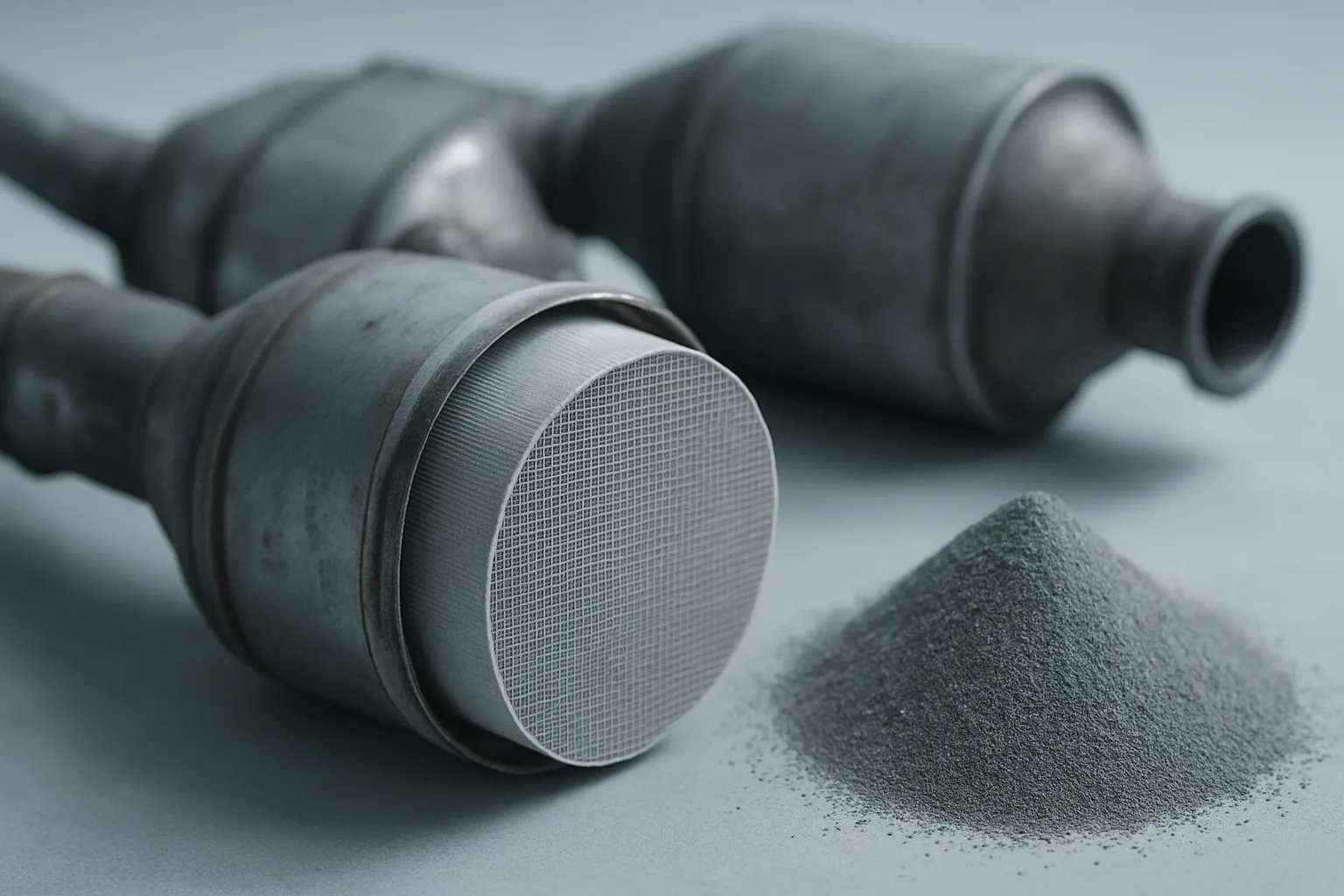
What's Actually Inside Your Catalytic Converter — and Why It's Worth Real Money
Most scrap sellers know their cats have value. Few know exactly why. That gap costs money. If you don't understand what drives palladium price today — and how it connects directly to your converter's payout — you're negotiating blind. That's a bad position to be in.
This article breaks down the precious metals inside catalytic converters, explains how each one affects scrap cat value, and shows you why getting competitive bids matters more than most sellers realize. Whether you're running a yard in Toledo or clearing out a shop across Ohio, this is the knowledge that changes how you sell.
The Three Precious Metals That Drive Scrap Cat Value
Every catalytic converter contains a ceramic or metallic substrate coated with a thin layer of platinum group metals (PGMs). These are the three metals buyers actually pay for. Strip away everything else — the steel shell, the ceramic honeycomb — and what remains is a small amount of material worth more per ounce than gold.
Here's what you're working with:
- Platinum (Pt): The most recognized PGM. Used heavily in diesel converters. Platinum helps oxidize carbon monoxide and unburned hydrocarbons. It's dense, durable, and consistently in demand from industrial refiners.
- Palladium (Pd): The dominant metal in gasoline-engine converters. Palladium handles oxidation reactions at lower temperatures, which makes it ideal for modern passenger vehicles. Palladium prices have historically been volatile — when supply tightens, values spike fast.
- Rhodium (Rh): The rarest of the three. Rhodium handles nitrogen oxide reduction — the hardest emission chemistry problem to solve. Because it's scarce, rhodium prices per ounce can dwarf both platinum and palladium. A small shift in rhodium content between two similar-looking converters can mean a significant difference in payout.
These three metals work together inside the converter's substrate. The exact blend varies by manufacturer, engine type, vehicle age, and emissions standard. That's why two cats that look identical on the outside can have completely different scrap values. Visual inspection alone tells you almost nothing.
Why the Palladium Price Today Changes Your Payout Tomorrow
Palladium is particularly important to understand because it directly impacts payout on the most common converter type — gasoline vehicle cats. When the palladium price today rises, buyers adjust their bids accordingly. When it drops, payouts follow. This isn't negotiable — it's math.
Palladium is mined primarily in Russia and South Africa. That geographic concentration makes the market sensitive to geopolitical events, currency shifts, and mining disruptions. In 2026, the market has continued to reflect ongoing supply chain pressures from both regions, which means staying current on spot prices isn't optional if you want to sell smart.
A few things to keep in mind about palladium and your scrap cat pricing:
- Spot prices fluctuate daily. What a buyer quotes on Monday may shift by Thursday.
- Payout percentages vary by buyer. A buyer offering 80% of assay value on a high-palladium cat is better than one offering 85% on a low-assay estimate.
- Assay accuracy matters. How your load gets processed and tested affects the final number. Demand documentation.
- Volume helps. Larger loads give you more leverage — and on a B2B scrap metal marketplace, more competitive bids.
Disclaimer: Precious metal prices fluctuate daily based on global market conditions. Always check current spot prices before selling. No price mentioned in this article constitutes a quote or guarantee.
How Toledo Scrap Yards Can Use PGM Knowledge to Negotiate Better
Toledo is a serious industrial city with a real scrap ecosystem. Yards and auto recyclers across the area handle significant converter volume — from domestic passenger cars to commercial fleet vehicles running through the region's logistics corridors. That volume is an asset. But only if you're using it right.
Here's the problem most Toledo sellers run into: they call one buyer, get one number, and take it. There's no reference point. No competition. No way to know if the offer reflects the actual palladium, platinum, and rhodium content in the load — or just what that buyer wants to pay today.
Using Toledo scrap metal services that connect you with multiple vetted buyers changes that dynamic entirely. Instead of one offer, you get competing bids. Instead of guessing, you get market-based price discovery. That's how professional scrap operations across Ohio are tightening up their margins in 2026.
Knowledge of PGM content gives you a baseline for evaluating offers. If you know your load is heavy in palladium-rich gasoline cats and the palladium price today is elevated, a lowball offer stands out immediately. You're not just accepting numbers — you're reading them.
What Affects Scrap Catalytic Converter Prices Beyond Metal Content
Metal content is the foundation of cat value, but it's not the only variable. Buyers factor in several additional elements when making an offer. Understanding these helps you present your load better and avoid leaving money behind.
Condition and completeness: Intact converters with their original substrates command better prices. Gutted or crushed cats lose value fast — the substrate is where the PGMs live. Don't let anyone gut your cats before assay unless you know exactly what you're trading away.
Identification accuracy: Many converters have serial numbers, part numbers, or OEM codes stamped on the body. These codes tell experienced buyers exactly what vehicle the converter came from and, by extension, the approximate PGM loading from the original manufacturing spec. Platforms that support serial tracking — like smashscrap.com — help document this data properly, which builds buyer confidence and can support better bids.
Volume and consistency: A one-off load of mixed, unidentified cats is harder to price accurately. A documented load, sorted by type with photos and serial references, gives buyers the information they need to bid competitively. It's basic: more information means less buyer risk, and less risk means better offers.
Market timing: Selling into a rising palladium market is better than selling into a declining one. That sounds obvious. But most sellers don't track spot prices — they sell when inventory piles up, regardless of timing. Even a general awareness of PGM market direction can help you make smarter hold-or-sell decisions.
How Platforms Like SMASH Change the Game for Scrap Cat Sellers
The traditional model for selling scrap cats is broken in a specific way: it relies on a single relationship with a single buyer. That buyer has no incentive to offer you the best price. You have no way to verify if the offer is fair. The whole arrangement favors the buyer.
SMASH runs catalytic converter sales through a competitive auction model with vetted buyers across North America. When you list a load — documented with photos, serial numbers where available, and accurate categorization — multiple buyers see it and compete. That competition is what drives price discovery. It's not a guarantee of any specific outcome, but more buyers means better price discovery. That's the core principle.
For sellers who want to get a fair price for your scrap catalytic converters, the shift from single-buyer negotiation to multi-buyer competition is significant. Especially when the load contains high-palladium gasoline cats where today's spot price is favorable. Every dollar of palladium content is worth fighting for — and competition is how you fight for it.
SMASH also handles the documentation side: photo records, auto-invoicing, and buyer vetting. For yards moving serious cat volume in Ohio and beyond, that infrastructure matters. It removes friction and reduces disputes after the sale.
Getting Started: What to Do Before You Sell Your Next Cat Load
You don't need to become a metallurgist to sell cats smarter. You need a few habits that put you in a stronger position every time.
- Check the palladium price today before you negotiate. Know the spot price. It takes 30 seconds and gives you a reference point immediately.
- Document your load. Photos, serial numbers, estimated counts by type. The more information you provide, the better buyers can bid.
- Don't accept the first offer. One offer is not a market. A market is what happens when multiple buyers compete for the same load.
- Use a platform that vets its buyers. Not every converter dealer near you is operating at the same standard. Vetted buyers reduce the risk of slow payment, disputes, and low-ball assay adjustments after the fact.
- Understand your cats by type. Gasoline passenger cats, diesel cats, and aftermarket cats all carry different PGM profiles. Sorting and identifying your load improves accuracy on both sides of the transaction.
If you're ready to find the best scrap cat prices today, the foundation is knowledge — and action. Knowing what drives converter value is step one. Getting competitive bids based on that value is step two. Platforms like SMASH make step two accessible for yards of every size.
For deeper dives into converter types, market timing, and how to prepare your loads for sale, read scrap catalytic converter guides built for sellers who want real information, not filler.
Frequently Asked Questions
Q: How does the palladium price today affect what I get paid for my scrap catalytic converters?
Palladium is the dominant precious metal in gasoline-engine catalytic converters, so when the palladium price today is high, payouts on gas cat loads tend to rise accordingly. Buyers price their bids based on current spot prices for platinum, palladium, and rhodium. Checking spot prices before you sell gives you a baseline to evaluate whether an offer is fair or well below market.
Q: Are scrap catalytic converter prices in Toledo different from other parts of Ohio?
The underlying PGM content that determines a converter's value is consistent — a specific cat is worth the same regardless of geography. However, local buyer competition, transportation costs, and individual yard pricing practices can cause variation in what you're actually offered. Using a platform that brings in buyers from across the region levels that playing field for Toledo sellers.
Q: What's the difference between platinum, palladium, and rhodium in a catalytic converter?
All three are platinum group metals (PGMs) that perform different chemical functions inside the converter. Platinum is common in diesel converters and oxidizes CO and hydrocarbons. Palladium dominates in gasoline converters and works at lower temperatures. Rhodium is the rarest, handles nitrogen oxide reduction, and commands the highest per-ounce price of the three. The mix of these metals determines the converter's scrap value.
Q: How do I find legitimate catalytic converter dealers near me?
Start by asking for references and verifying that any buyer is transparent about their assay and settlement process. Vague pricing, no documentation, or pressure to sell quickly are red flags. Using a vetted B2B scrap metal marketplace — rather than cold-calling individual dealers — filters out buyers who aren't operating at a professional standard.
Q: Does it matter if my catalytic converters are from foreign vehicles for scrap pricing?
Yes, it can matter significantly. Foreign vehicle cats — particularly from Japanese and European manufacturers — often carry different PGM loadings than domestic equivalents. Some are higher, some lower. Accurate identification by serial number or OEM code is the best way to ensure your load is valued correctly rather than lumped into a generic estimate that may undervalue what you have.
The best time to sell smart is when you understand what you're selling. If your next cat load is sitting in the yard and you're not sure what it's worth, don't guess — get competing bids from buyers who've been vetted and know exactly what platinum, palladium, and rhodium are trading at right now. Head to best-scrap-cat-prices.com for a free quote and find out what your converters are actually worth in today's market.
Stay sharp on scrap metal markets and industry news — follow SMASH on LinkedIn at linkedin.com/company/scrap-metal-auction-sales-hub for regular updates on PGM pricing trends, platform news, and insights built for serious scrap operators.
```