Why the Palladium Price Today Determines What Your Catalytic Converter Is Actually Worth
Most sellers leave serious money on the table — not because they have the wrong converters, but because they don't know which vehicles carry the most precious metal. The palladium price today is one of the biggest drivers of scrap cat value, and if you're sitting on a pile of cores without knowing what's inside them, you're guessing. That's expensive guessing.
This guide breaks down the most valuable catalytic converters by vehicle make and model, explains what actually drives catalytic converter scrap metal value, and shows you how to stop leaving money on the floor of your yard.
Disclaimer: Metal prices fluctuate daily. Always check current rates before selling. The information here reflects general market knowledge as of June 2026 and should not be used as a substitute for a live quote.
---What Makes One Catalytic Converter Worth More Than Another?
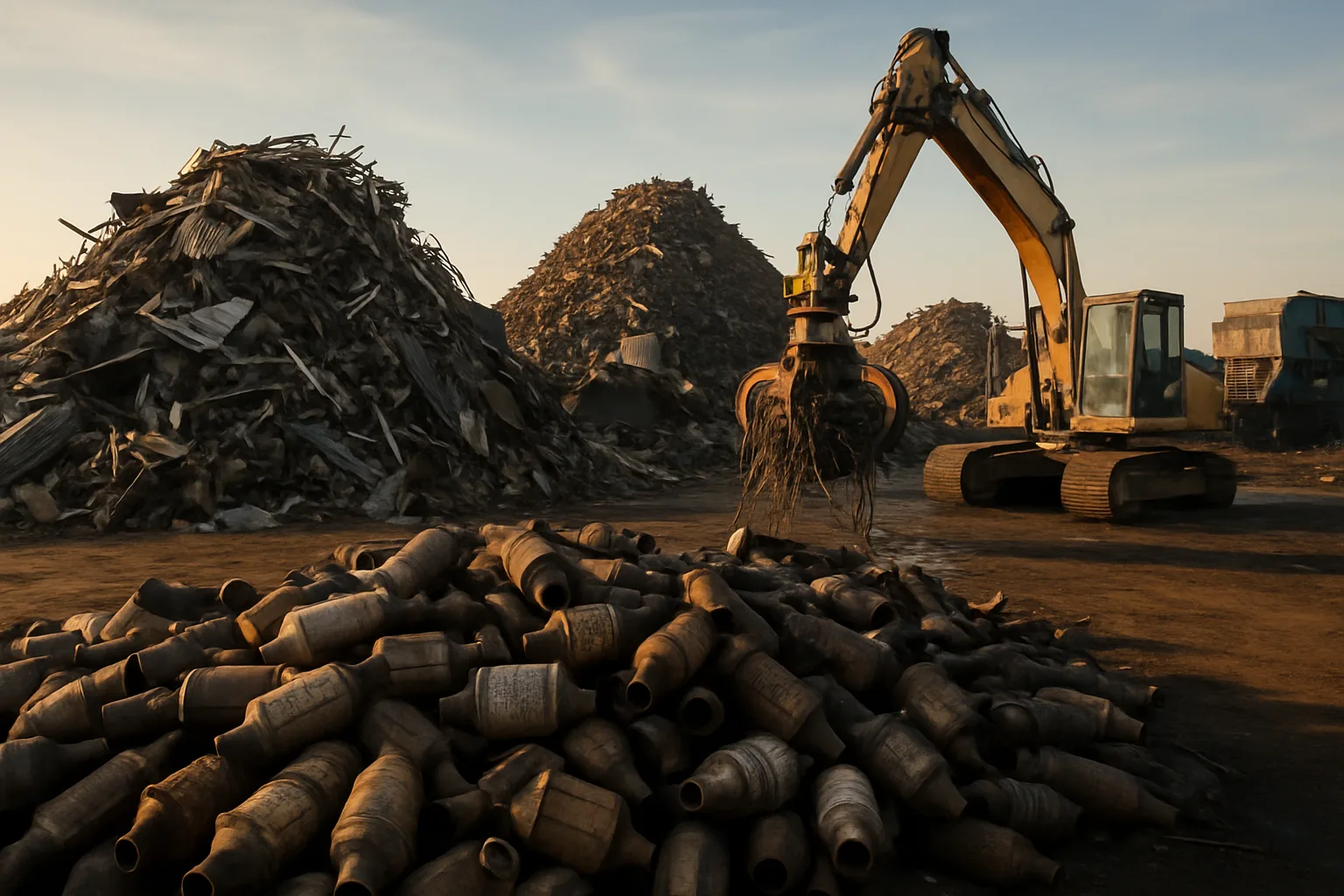
Three precious metals determine what a cat converter is worth: palladium, platinum, and rhodium. The substrate inside the converter — that honeycomb-shaped ceramic or metallic core — is coated with these metals to trigger the chemical reactions that reduce exhaust emissions. The more loading per gram, the higher the scrap value.
The palladium price today gets the most attention because palladium dominates the substrate loading in gasoline-powered vehicles, which make up the majority of converters on the road. When palladium runs high, gasoline vehicle cats are king. When rhodium spikes — which it does unpredictably — certain hybrid and performance vehicle cats jump in value fast. Platinum tends to carry more weight in diesel converters.
Beyond the metals themselves, a few other factors move the needle on value:
- Substrate condition — cracked, wet, or burned substrates reduce recoverable metal
- Country of manufacture — OEM converters from Japanese and German manufacturers often carry higher loadings than aftermarket replacements
- Vehicle mileage and age — lower mileage usually means better substrate integrity
- Aftermarket vs. OEM — aftermarket cats are almost always worth significantly less
If you're managing volume and trying to track what's coming across your scale, solid scrap metal inventory management isn't optional — it's how you know what you have before a buyer makes you an offer you can't evaluate.
---The Most Valuable Catalytic Converters by Make and Model
Not all cats are created equal. Here's a practical breakdown of the vehicles known to carry high-value converters. These aren't guarantees — individual units vary, and the palladium price today affects what any specific cat pays out on any given day. But these are the makes and models that consistently show up at the top of buyer lists.
Toyota
Toyota builds some of the most valuable cats in the market. The Toyota Prius is the standout — its hybrid system means the catalytic converter works less hard, preserving the precious metal substrate far longer than in a conventional combustion vehicle. Prius cats frequently command premium prices. The Toyota Tundra and 4Runner (especially V8 models) also carry strong-loading converters. The Toyota Land Cruiser is another name that makes buyers pay attention.
Ford
The Ford F-250 and F-350 with gasoline V8 and V10 engines carry large-format converters with solid precious metal loading. The Ford Mustang, particularly older V8 models, is another consistent performer. Ford trucks are common across Oregon and the Pacific Northwest, which means Portland yards often see a steady volume of them.
Honda
The Honda Accord and Honda Odyssey are known in the industry for producing reliable mid-to-high value cats. Older Accord V6 models in particular show up well on assay results. The Honda Pilot is another one worth watching.
Lamborghini, Ferrari, and Exotic Vehicles
High-displacement performance engines require more aggressive emissions control. Exotic vehicles carry converters that can be worth multiples of a standard passenger car cat. These aren't volume plays, but when one crosses your scale, you want to know what you have. find the best scrap cat prices today before you move any high-value unit — the spread between a bad offer and a good one on an exotic cat can be significant.
BMW and Mercedes-Benz
European luxury vehicles — especially older V8 and V12 models — tend to carry premium-loaded converters. The BMW 7 Series and X5, along with the Mercedes-Benz S-Class and ML-Class, appear regularly on high-value converter lists. The emissions requirements for European markets historically drove higher precious metal loading, even on vehicles sold in the U.S.
Dodge and GM
Large displacement American trucks and SUVs from Dodge and GM carry respectable cats, though they're typically not at the very top of the value scale. The Dodge Ram 2500 with a Hemi and the Chevy Silverado HD are worth knowing. Volume sellers working Portland scrapyards often see these in bulk — and bulk matters if you're pricing them correctly.
---How Scrap Catalytic Converter Prices in Portland Stack Up Against the Market
Portland has an active scrap ecosystem. Oregon's emissions standards and the age profile of the vehicle fleet in the Pacific Northwest mean catalytic converters move through Portland yards regularly. The challenge isn't volume — it's price discovery. One buyer, one phone call, one number. That's how most transactions still happen, and it's how sellers consistently undersell.
The problem with a single-buyer model for scrap catalytic converter prices Portland sellers face isn't unique to the city — it's a national pattern. But in a market like Portland, where regional buyers know sellers don't always have full visibility into what their cats are worth, the spread between the first offer and a competitive offer can be real money.
Platforms like SMASH Scrap — where verified buyers bid on your metal change that dynamic. When your documented inventory goes in front of multiple vetted buyers simultaneously, competition replaces guessing. That's not marketing — that's how price discovery actually works.
If you're managing a yard in Oregon and want to understand how local services connect to national buyer networks, check out Portland scrap metal services for location-specific information.
---Scrap Metal Inventory Management for Catalytic Converter Sellers
Here's a reality most yards know but don't act on: undocumented inventory is undervalued inventory. When a buyer can't verify what they're bidding on, they price in risk. That risk comes out of your pocket.
Good scrap metal inventory management for catalytic converters means capturing the right information before you go to market:
- VIN lookup — if the converter came off a specific vehicle, link it. OEM converters are worth more than aftermarket, and documenting that matters.
- Serial number or part number — most OEM cats have identifiable markings. Capture them. Buyers use these to identify substrate type and loading.
- Photo documentation — photos of the substrate condition, end pipes, and any identifying stamps build buyer confidence and reduce disputes.
- Condition notes — note any cracks, water damage, or burn-through. Transparency upfront protects you from post-sale price adjustments.
SMASH's inventory tool is built to handle exactly this workflow. VIN lookup, serial tracking, photo uploads — it's not paperwork for its own sake. It's documentation that gets you better bids from buyers who can actually see what they're buying. More confidence from buyers means better price discovery for you.
Want to go deeper on how to navigate the converter market? Read scrap catalytic converter guides covering everything from pricing basics to documentation strategy.
---What to Do Before You Sell Your Next Load of Cats
Selling scrap catalytic converters isn't complicated. But doing it right — especially when the palladium price today is moving — takes a few deliberate steps.
Step 1: Identify what you have. Use a converter database or VIN lookup to match units to known types. High-value makes and models deserve more attention before they move.
Step 2: Document the load. Photos, part numbers, condition notes. Buyers reward transparency with better bids. Undocumented loads get lowball offers.
Step 3: Get competitive bids. Don't call one buyer and settle. Competition — even among two or three vetted buyers — reveals the real market price for your load.
Step 4: Understand the settlement terms. Know whether you're selling on a per-unit basis or sending to an assay processor. Understand the timeline and how final payment is calculated.
If you're ready to stop guessing and start selling with actual market data behind you, get a fair price for your scrap catalytic converters — it starts with knowing what you have and putting it in front of buyers who compete for it.
---Frequently Asked Questions
Q: How does the palladium price today affect what I get for my scrap catalytic converters?
Palladium is the dominant precious metal in gasoline vehicle catalytic converters. When the palladium price rises, the value of most scrap cats rises with it — and when it drops, cat prices follow. Checking the palladium spot price before you sell gives you a baseline for evaluating any offer you receive.
Q: Which catalytic converters are worth the most money right now?
Toyota Prius converters are consistently among the highest-value units due to preserved substrate from the hybrid drive cycle. Exotic vehicles, large-displacement American trucks, and European luxury V8s also tend to carry premium cats. OEM converters from any make will outperform aftermarket replacements.
Q: Are scrap catalytic converter prices in Portland different from other U.S. cities?
The underlying precious metal values are the same nationally — palladium, platinum, and rhodium trade on global markets. What varies locally is the competitive landscape. Portland sellers with access to multiple vetted buyers tend to see better pricing than those relying on a single regional buyer.
Q: How do I know if my catalytic converter is OEM or aftermarket?
OEM converters typically have manufacturer markings, part numbers, or heat stamps that identify them. Aftermarket units often look different in construction and may have generic or third-party branding. A VIN lookup tied to the vehicle the cat came off can also help confirm authenticity and expected metal loading.
Q: What's the best way to sell a large load of catalytic converters in Oregon?
Document your inventory first — photos, part numbers, condition notes. Then get your load in front of multiple buyers simultaneously rather than calling one yard and accepting the first number. Platforms like SMASH connect sellers with vetted buyers who compete for documented loads, which is how you get closer to actual market value instead of one buyer's margin.
---The market rewards sellers who know what they have and put it in front of real competition. Whether you're moving a handful of Prius cats or a mixed pallet of cores from a Portland dismantler, the process is the same: document, compete, sell with data. Find the best scrap cat prices for your load — start with a free quote at best-scrap-cat-prices.com.
Stay sharp on scrap market moves and metal price updates — follow SMASH on LinkedIn for industry insights, buyer market trends, and scrap metal news worth knowing.